How to Write an AI Policy for Employees in Malaysia
By Dr. Muhamad Hariz Bin Muhamad Adnan
Short answer: To write an AI policy for employees in Malaysia, start with the work people actually do. List AI-assisted use cases, assign an accountable owner, define permitted data, classify higher-risk uses, require meaningful human review, create an incident route, and test the rules with realistic English and Bahasa Malaysia requests. Publish a versioned policy only after employees can use it to make consistent decisions.
A useful policy is not a collection of slogans. It answers practical questions: May I paste this information into an AI tool? Who checks the output? When must I stop? Where do I report a problem? The policy should also link to a maintained use-case register and approved-tools list because models, features, contracts and organisational needs change.
1. Define the purpose and scope
Begin with one paragraph explaining why the organisation uses AI and what the policy covers. Include employees, contractors, interns and temporary staff where relevant. State whether it applies to standalone chatbots, image and audio tools, coding assistants, office-suite features, customer-service systems and AI embedded in other software.
Define “AI-assisted work” broadly enough that staff cannot bypass the policy by saying a feature was built into an approved application. At the same time, keep the policy tied to organisational work rather than personal experimentation outside the organisation’s systems and data.
2. Inventory use cases before approving tools
A tool name does not describe the risk. Drafting a public social-media caption and ranking job applicants may use the same provider but create very different consequences. Record each workflow separately: purpose, team, owner, input data, output, affected people, decision influenced, model or vendor, review method and status.
Start with short interviews rather than a blame-focused audit. Ask staff which tasks are slow, where AI is already used, what information enters the system and who relies on the result. Mark unknowns openly. An unknown data flow should trigger investigation or a restricted pilot, not an assumption that the use is safe.
3. Assign accountable roles
Every use case needs a named owner who can approve changes, provide evidence and stop the workflow. The policy should also identify the people responsible for privacy, security, subject-matter review, records and incident response. A small Malaysian business may combine roles, but it should record conflicts or missing expertise and seek qualified help for higher-impact or regulated work.
Give reviewers real authority. If a manager is expected to challenge an AI-generated recommendation, the process must allow rejection, revision, escalation and reversal without penalising the reviewer for slowing automation.
4. Set clear data boundaries
Write concrete examples of information employees may and may not enter. Distinguish public material, approved internal information, confidential business records, personal data, client data, credentials, security-sensitive material and sector-specific records. Tell staff to minimise data, remove unnecessary identifiers and use synthetic examples during early tests.
Link the policy to the organisation’s authoritative privacy, retention, access and breach procedures. Malaysia’s Personal Data Protection Commissioner publishes the Personal Data Protection Act, amendments and official guidance. The applicable duties depend on the organisation and processing activity, so the policy should route material questions to the responsible privacy or legal role rather than inventing a universal answer.
5. Separate allowed, restricted and prohibited uses
Employees understand examples better than abstract warnings. An allowed use might be brainstorming headings from public information with human review. A restricted use might be drafting a customer response that includes approved account facts and requires a trained employee to verify every material statement. A prohibited use might include entering credentials into an unapproved service, creating deceptive impersonation, or making an unreviewed high-impact decision about a person.
Do not let a low-risk approval travel to a new purpose. Formatting a job description does not approve automated candidate ranking. Summarising public health information does not authorise diagnosis. The new use should receive its own record, risk route and qualified review.
6. Use a simple, proportionate risk tier
Consider credible harm, number of people exposed, data sensitivity, degree of automation, reversibility, vulnerability of affected users and difficulty of detecting an error. Define three or four tiers that lead to actions. A label without an approval route, required controls and stop conditions is decoration.
Examples of stop conditions include missing authority, prohibited data, unavailable human appeal, failed critical testing, misleading identity, broken source links or an unresolved security concern. Preserve uncertainty in a proposed or restricted status until the evidence is available.
7. Translate Malaysia’s AIGE principles into controls
Malaysia’s official Practical Guide on AI Governance and Ethics presents seven responsible-AI principles: fairness; reliability, safety and control; privacy and security; inclusiveness; transparency; accountability; and pursuit of human benefit and happiness. For each relevant principle, name a control, evidence, owner and review date.
For example, “be transparent” might become a plain-language notice, identification of the human decision-maker, disclosure of a material limitation and a correction route. “Be fair” might become representative test cases, review by affected groups where appropriate, recorded failures and a rule for escalation.
8. Make human oversight meaningful
The policy should state what the reviewer checks: factual accuracy, missing context, rights to source material, tone, privacy, bias, instructions and destination. The reviewer needs the original evidence and enough time to inspect it. High-impact outputs may require independent subject-matter review rather than approval by the person who built the workflow.
A forced click after an automated action has already occurred is not meaningful oversight. Design the process so a person can stop the action, change the result and correct downstream records.
9. Verify facts, sources and professional claims
AI output may be incomplete, outdated, biased or wrong. Require staff to verify important facts against current, authoritative sources and to preserve direct links where decisions depend on them. Prohibit fabricated citations, testimonials, prices, policies and statistics.
For legal, medical, financial, safety, employment or other consequential content, define which qualified role must review the work. A disclaimer does not replace evidence or professional responsibility.
10. Evaluate vendors consistently
Before a demonstration, write must-have and disqualifying criteria. Request dated evidence about data handling, storage, access, subprocessors, training use, model changes, content rights, security, incidents, export and deletion. Record unanswered questions instead of converting marketing language into a control.
Test normal, edge and misuse cases with synthetic data. Include English, Bahasa Malaysia and realistic mixed-language requests when employees or customers use them. Record the input class, expected behaviour, observed result, severity, reviewer and regression status.
Use five gates before releasing an AI workflow
A policy becomes operational when it changes a release decision. Before a pilot or recurring workflow goes live, check five gates in sequence: purpose, data, risk and controls, evidence, and accountable human release. A failed gate returns the exact use case or output to repair, escalation or retirement rather than allowing a vague category approval.
The final reviewer should record the use-case ID, owner, purpose, affected people, approved data boundary, model or provider context, test evidence, unresolved limitations and one decision. Reopen the relevant gates after a material change in purpose, audience, data, provider, model, integration, performance, incident history or applicable rules.
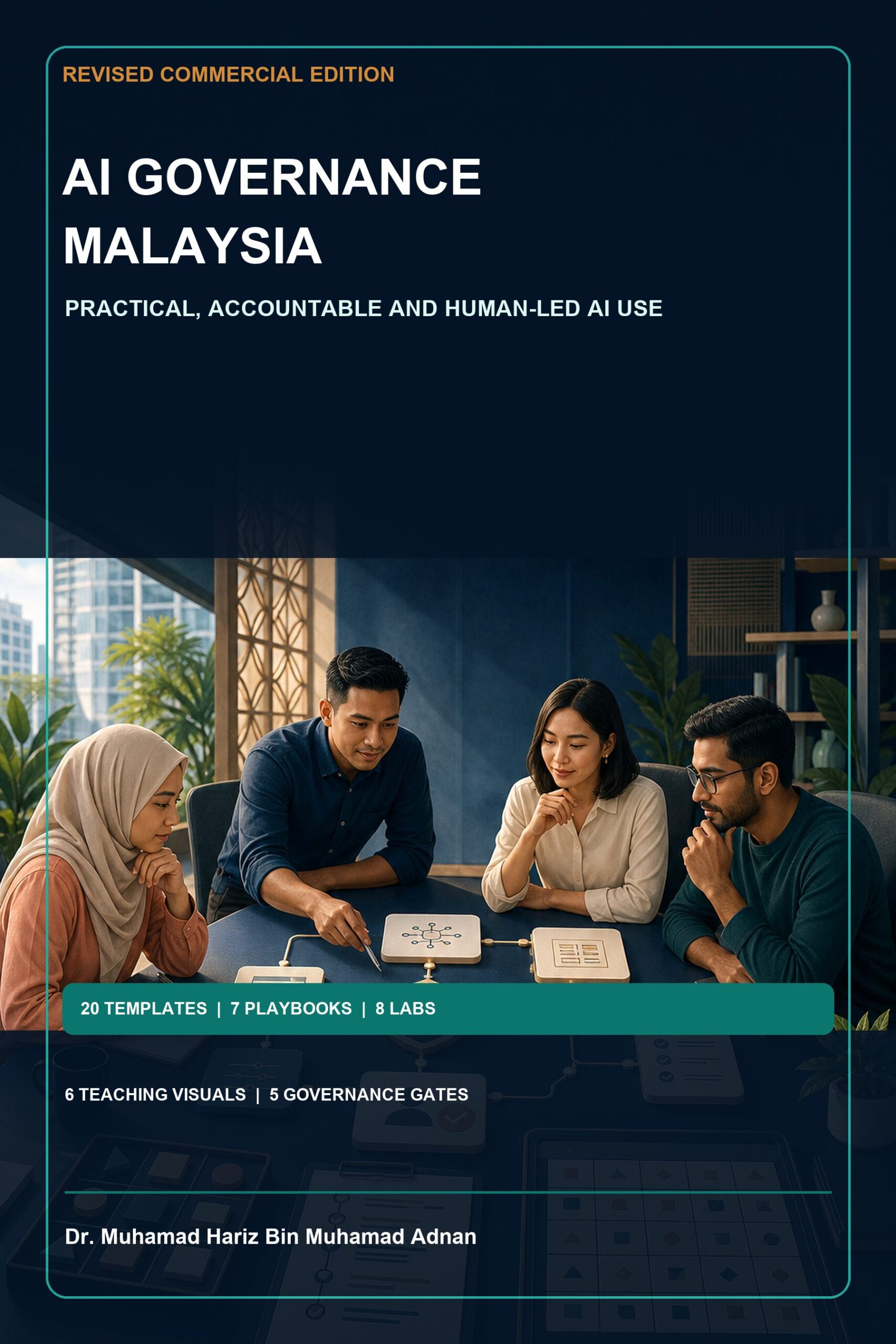
The complete AI Governance Malaysia commercial field guide provides 20 reusable templates plus six visual decision aids for the register, risk triage, data boundary, human review, vendor evidence, incidents, release and retirement.
11. Create an easy incident and complaint route
Employees should know how to report harmful output, unauthorised disclosure, suspicious prompts, identity misuse, discriminatory behaviour, failed human control or a boundary breach. Capture the time, use case, output, impact, data involved and immediate action without asking the reporter to diagnose the root cause.
The response should protect people, contain the use, preserve evidence securely, engage authorised roles, correct affected communications or records and decide whether the workflow may resume. Do not quietly regenerate the answer and erase what happened.
12. Monitor change and retire stale uses
An approval should name review dates and change triggers. Reassess after a new model, dataset, integration, audience, purpose, contract, incident or material performance change. Rerun the relevant tests and record whether controls still work.
Retirement is a controlled process: remove access, disable integrations, complete required export or deletion, update the register and inform affected owners. Staff access that remains after a pilot closes is a governance failure even if the tool is no longer discussed.
13. Test the policy with Malaysian workplace scenarios
Give employees short requests and ask them to decide: allowed, restricted, prohibited or escalate. Useful scenarios include an online seller drafting a refund reply, a lecturer handling identifiable student work, an agency using a client brief, HR formatting a job description, a professional firm summarising public research and a public-facing team drafting an FAQ.
Include ambiguous cases. Ask what data may enter, who reviews, which source must be checked, who is affected and what would stop the task. If two trained employees reach conflicting decisions, improve the policy wording or examples.
Starter AI policy structure
- Purpose, scope and definitions
- Accountable roles and decision authority
- Approved accounts, tools and use-case register
- Allowed, restricted and prohibited uses
- Data, confidentiality and retention boundaries
- Risk tiers, approval conditions and stop rules
- Human review and source verification
- Transparency, correction and appeal
- Security, incidents and complaints
- Monitoring, change, retirement, owner and version
Five questions employees should ask
- May I enter this information into this approved account?
- Could the output affect a person, opportunity, safety decision or professional duty?
- What source must I verify, and am I qualified to review the result?
- Who can stop, reject or escalate this use?
- Where do I report an error, complaint, data issue or suspicious behaviour?
Use current official sources
Malaysia’s Practical Guide on AI Governance and Ethics explains the AIGE principles and AI lifecycle. The Jabatan Digital Negara public-sector AI adoption guidance covers roles, adoption procedures, risk management and self-assessment. The Personal Data Protection Commissioner publishes the Act, amendments and official guidance. For a broader regional reference, see the ASEAN Guide on AI Governance and Ethics. Confirm which requirements apply to the actual organisation and use case.
FAQ
Is AIGE mandatory law?
The official Malaysia.gov description characterises AIGE as voluntary guidance. It does not replace applicable law, sector rules, contracts or professional duties.
Can one policy approve every AI tool?
No. Approval should state the account, purpose, data, audience, integration and conditions. Maintain a current approved-tools list and use-case register.
Does a human-review sentence make a use safe?
No. The reviewer needs competence, evidence, time and authority to disagree, escalate and reverse the result.
How long should the policy be?
Use the shortest document that answers real decisions and links to maintained registers, forms and specialist procedures. Test comprehension instead of judging quality by page count.
Conclusion
Begin with visibility, not paperwork. Name the use, owner, data, affected people and decision. Apply proportionate controls, test the workflow and give staff a fast route to ask, stop and report. Review the system whenever material conditions change.
Ready to build the full system? Get AI Governance Malaysia for RM9.99 and use the 20 templates, seven Malaysian role playbooks, eight guided labs, twelve scenarios, six teaching visuals, five release gates and 14-day rollout plan.