Workplace Safety Inspection Checklist Malaysia: 20 Evidence Checks Before Close-Out
Short answer: A reliable workplace safety inspection checklist for Malaysia must preserve original observations, separate human risk judgement from AI assistance, verify controls with evidence and block close-out when any critical gate fails.
What this checklist is for
A workplace inspection becomes useful only when it produces traceable observations, appropriate escalation and evidence that corrective work was verified. AI can help organise records and flag missing fields, but it cannot decide whether a hazard is acceptable, select controls for a real workplace or approve close-out. Use the twenty checks below before a manager, safety professional or other authorised person signs the inspection package.
1. Scope and authority
Name the site, zone, activity, shift, people potentially exposed and the person authorised to review the inspection. Record the internal procedure and current official sources that apply. If the inspection covers only a warehouse aisle, do not let a summary imply that the whole facility was reviewed.
2. Original observation quality
Keep date, time, exact location, activity, observed condition and the original photograph or record identifier. Separate what the inspector saw from what someone inferred. Words such as unsafe, compliant or low risk are conclusions unless the supporting criteria and evidence are shown.
3. Hazard and exposure context
Describe the source, situation, potential event and who could be exposed. Record normal, abnormal and emergency conditions where relevant. Never allow AI to invent a measurement, frequency, likelihood, severity, health effect or causal chain merely to make the record sound complete.
4. Immediate protection and escalation
Urgent conditions must follow the organisation's human escalation and stop-work arrangements before optional AI processing. The checklist should show what immediate protection was taken, who was notified, when the notification occurred and what remains unresolved.
5. HIRARC preparation boundary
AI may sort authorised activity steps, current controls and evidence gaps into a preparation pack. Competent people must perform hazard identification, risk assessment, control selection and approval through the organisation's authorised process. A generated score is not a HIRARC result.
6. Control hierarchy challenge
Ask what was considered at elimination, substitution, engineering, administrative and personal-protective levels. Do not accept training, reminders or PPE as an automatic answer when higher-order controls may be reasonably practicable. Rejected options need a human-authored reason.
7. Control verification
A procedure saying that a guard, barrier, interlock, ventilation system or traffic separation exists is not proof that it worked at the relevant time. Link the claim to installation, inspection, test, maintenance, defect and limitation evidence.
8. Corrective action design
Each finding needs an owner, due date, immediate containment, durable action and escalation trigger. Avoid vague actions such as monitor, remind or be careful. The record should identify the changed condition that future verification will test.
9. Close-out evidence
Define the acceptance test before closure. A labelled photograph or invoice may show activity, but not necessarily a functioning control. Record the method, date, verifier, result, residual concern and whether the action was reopened.
10. Worker and contractor participation
Check whether workers who perform the task were consulted and whether language, shift, disability or access barriers affected the evidence. For contractor work, name the host and contractor owners, shared hazards, permit interface, handover and stop-work contacts.
11. Privacy and dignity
Inspection media can expose faces, health information, vehicle plates and personal behaviour. Keep only data necessary for the defined purpose. Document access, security, retention and deletion. Avoid profiling workers from sparse observations or using safety reporting as covert performance surveillance.
12. AI task specification
Write what the system may do: extract labelled fields, group supplied records, compare with an approved schema and flag gaps. Write what it may not do: assign risk, interpret law, diagnose injury, blame a person, issue a permit, approve work or close an action.
13. Testing and change control
Before live use, test synthetic normal, missing, contradictory, ambiguous, urgent, injected and out-of-scope cases. Save expected and actual results. Record prompt, model and configuration changes, then rerun the challenge deck before the changed system processes operational records.
14. Balanced measures
Read inspection and closure counts beside critical open items, overdue duration, recurrence and verification failures. A green average must never hide a critical hold. Treat favourable activity numbers as a prompt for investigation, not proof of a safer workplace.
15. Five-gate close-out
Require separate evidence for authority and scope, record integrity, control verification, AI and data safety, and accountable human approval. One critical failure holds the affected package. Conditional release must state limits, owner and expiry.
Malaysian example
A Shah Alam warehouse identifies repeated obstruction near a pedestrian route. AI groups six supplied observations and flags that two lack time and shift details. The supervisor protects the route immediately, workers explain peak receiving conditions, the safety reviewer challenges higher-order traffic separation options and an independent verifier later tests the changed route. The model never labels the area safe.
Prompts you can adapt
Use these only with authorised, minimised data: “Extract the record ID, location, date, observed condition and missing mandatory fields. Cite each source ID. Do not rate risk or recommend controls.” Another useful prompt is: “Compare these corrective-action records with the approved closure schema. List missing evidence and contradictions. Do not decide whether an action is closed.”
Safety and fact-checking
Open the cited official source, confirm issuer and version, test the statement against the actual workplace context and ask a competent human reviewer to record the interpretation. If the source, measurement or condition cannot be verified, label it unknown and escalate. Never ask a model to fill a safety-critical blank.
A twenty-minute review routine
Begin with one adverse or overdue finding rather than the cleanest record. Spend five minutes tracing every material statement to the original observation and current source. Spend five minutes checking whether the claimed control exists, works and has a named owner. Spend five minutes testing privacy, prompt boundaries and unresolved contradictions. Use the final five minutes for an accountable reviewer to record pass, hold or fail with a reason. If the review cannot be completed inside the bounded record, do not invent certainty; open an action for the missing evidence.
What to do after a failed check
Protect people first and follow the organisation's urgent escalation route where required. Preserve the original record, system version and source set. Describe the failure precisely: missing authority, broken traceability, unverified control, exposed personal data or absent approval. Name an owner, due date and retest method. Review whether earlier outputs share the same defect. Tell affected reviewers which decisions may be unreliable and prevent the same workflow from processing new records until the failed control is restored. A correction is complete only when the affected evidence is rebuilt, independently checked and either approved with stated limits or kept on hold.
Twenty evidence checks before close-out
- Scope, location, activity, shift and exclusions are explicit.
- The accountable reviewer and urgent escalation route are named.
- Current official and internal sources are registered with retrieval dates.
- Every observation retains its original record or media identifier.
- Fact, inference, assessment, action and approval are separate.
- Unknown, not observed and not applicable are distinct states.
- No measurement, likelihood, severity or causal claim was invented.
- HIRARC judgement remains with authorised competent people.
- Higher-order controls were considered before administrative controls or PPE.
- Claimed controls have inspection, test or maintenance evidence.
- Corrective actions have owners, dates and durable acceptance tests.
- Closure evidence proves the changed condition, not merely activity.
- Workers and contractor interfaces were meaningfully consulted.
- Personal and confidential data were minimised before processing.
- AI permissions and prohibitions are written and testable.
- Synthetic adverse cases passed before live use.
- Prompt, model and source changes are logged and retested.
- Critical holds remain visible outside aggregate metrics.
- All five gates were reviewed independently.
- Human approval records the reason, limitations and next review date.
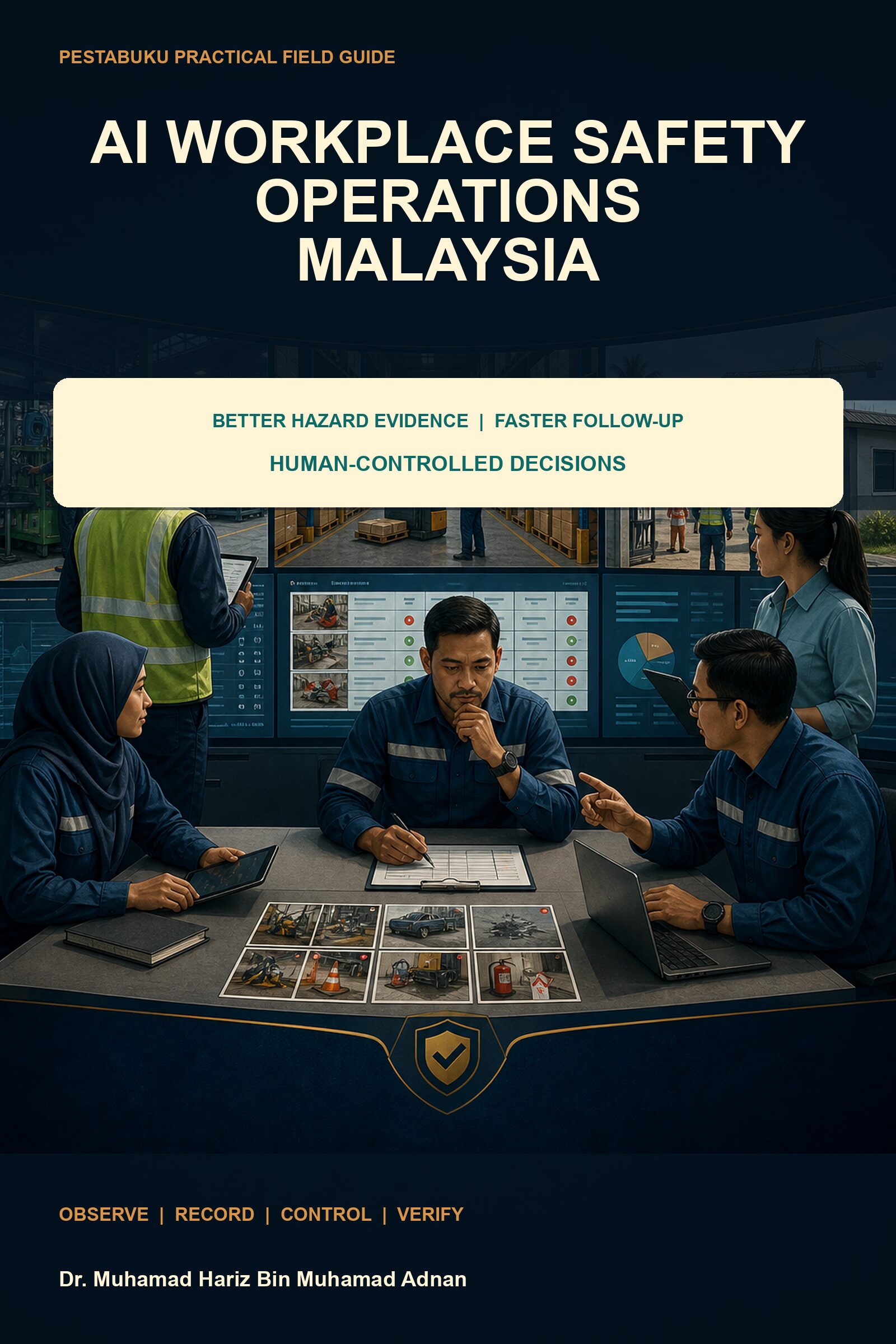
Need the complete operating system? Get AI Workplace Safety Operations Malaysia for RM9.99 with twenty tools, seven role playbooks, eight labs, failure clinics and a fourteen-day rollout plan.
Frequently asked questions
Can AI calculate our HIRARC?
Use it only to organise authorised inputs and gaps. Human assessors must identify hazards, assess risks, select controls and approve the record.
Is a photograph enough to close a finding?
Not usually. Apply a pre-defined acceptance test and record the verifier, method, date, result and residual limitation.
Can we upload employee photographs?
Only after purpose, necessity, privacy, security, access, retention and vendor handling are reviewed. Remove unnecessary identity.
What is the safest first pilot?
A synthetic-data check for missing identifiers in one controlled inspection form, with no impact on real decisions.
Does this checklist prove legal compliance?
No. It is an evidence-quality aid. Verify current Malaysian requirements and obtain competent workplace-specific advice.
Official sources
- DOSH HIRARC Guidelines 2008
- DOSH Occupational Safety and Health Act 1994, reprint as at 1 June 2024
- Malaysia National AI Office AI Governance and Ethics guide
- Malaysia Personal Data Protection principles
- NIST Generative AI Profile
Build the workflow, not just the checklist. Download the full AI Workplace Safety Operations Malaysia ebook for RM9.99 and adapt its evidence controls to your authorised process.
By Dr. Muhamad Hariz Bin Muhamad Adnan. Educational information only; not legal, medical, engineering, occupational-safety or compliance advice.