Food Safety Audit Checklist Malaysia: 20 Evidence Checks Before Review
By Dr. Muhamad Hariz Bin Muhamad Adnan
Short answer: A useful food safety audit checklist in Malaysia starts with the exact premise, product and process, then checks current authority, controlled procedures, training, supplier and lot evidence, time-temperature records, sanitation, complaints, corrective action, traceability and accountable approval. AI can help organise records and flag gaps, but it must not decide whether food is safe, invent a missing entry or authorise release.
For Malaysian food businesses, the practical problem is rarely a lack of forms. It is the gap between a completed form and an evidence trail that another reviewer can reproduce. The Ministry of Health describes a food-safety framework under the Food Act 1983 and subsidiary regulations, including the Food Hygiene Regulations 2009, while programmes such as MeSTI, GMP and HACCP have distinct roles. Always verify which current requirements and schemes apply to your own premise.
Use the checklist as an evidence map
Do not turn this list into twenty yes-or-no ticks. For each item, name the source record, owner, period, exception and reviewer. If evidence is missing, mark HOLD and investigate. A generated summary is not proof that a control happened.
- Boundary: identify the premise, product family, process start and end, outsourced steps and delivery interface covered by the review.
- Decision rights: name who may stop work, hold stock, assess an exception, approve corrective action and authorise release.
- Current authority: retain direct official links, versions or retrieval dates and the qualified person who interprets applicability.
- Controlled procedures: confirm the version in use matches the task, equipment and product rather than a retired or generic copy.
- Premise map: connect zones, people flow, material flow, waste, equipment and record families using stable identifiers.
- Training and competence: tie each role to the work performed, supervision and current competence evidence; do not rely on job titles.
- Product description: verify approved ingredients, packaging, intended use, storage, distribution and shelf-life basis.
- Process flow: walk the actual process and reconcile equipment, rework, outsourced steps and recent changes with the documented flow.
- Supplier and material status: link supplier site, material code, specification, declarations, approval and change notices.
- Lot traceability: test backward and forward links through receipts, production, rework, finished lots, waste and destinations.
- Time and temperature: bind readings to the approved criterion, device, unit, timestamp, batch and exception route.
- Equipment status: verify calibration, maintenance, restriction and hand-back evidence before relying on affected measurements.
- Cleaning and sanitation: connect schedule, completion, method, materials, verification, exception and release.
- Allergen and label change: trace ingredient substitutions, storage, schedule, cleaning, rework and current label effects to qualified approval.
- Pest control: review observations by location, action and effectiveness rather than treating contractor attendance as the outcome.
- Complaint triage: preserve the original allegation, product link, urgency trigger, privacy boundary and human escalation.
- Corrective action: separate immediate containment, investigation, cause, correction, preventive change and effectiveness review.
- AI data boundary: use an approved minimum-data copy, exclude unnecessary names and contacts, and record provider, account and retention conditions.
- AI output verification: require source locations and UNKNOWN states, sample flagged and unflagged records, and log rejected outputs.
- Final approval: run independent gates for authority, record integrity, control verification, AI/data safety and authorised sign-off.
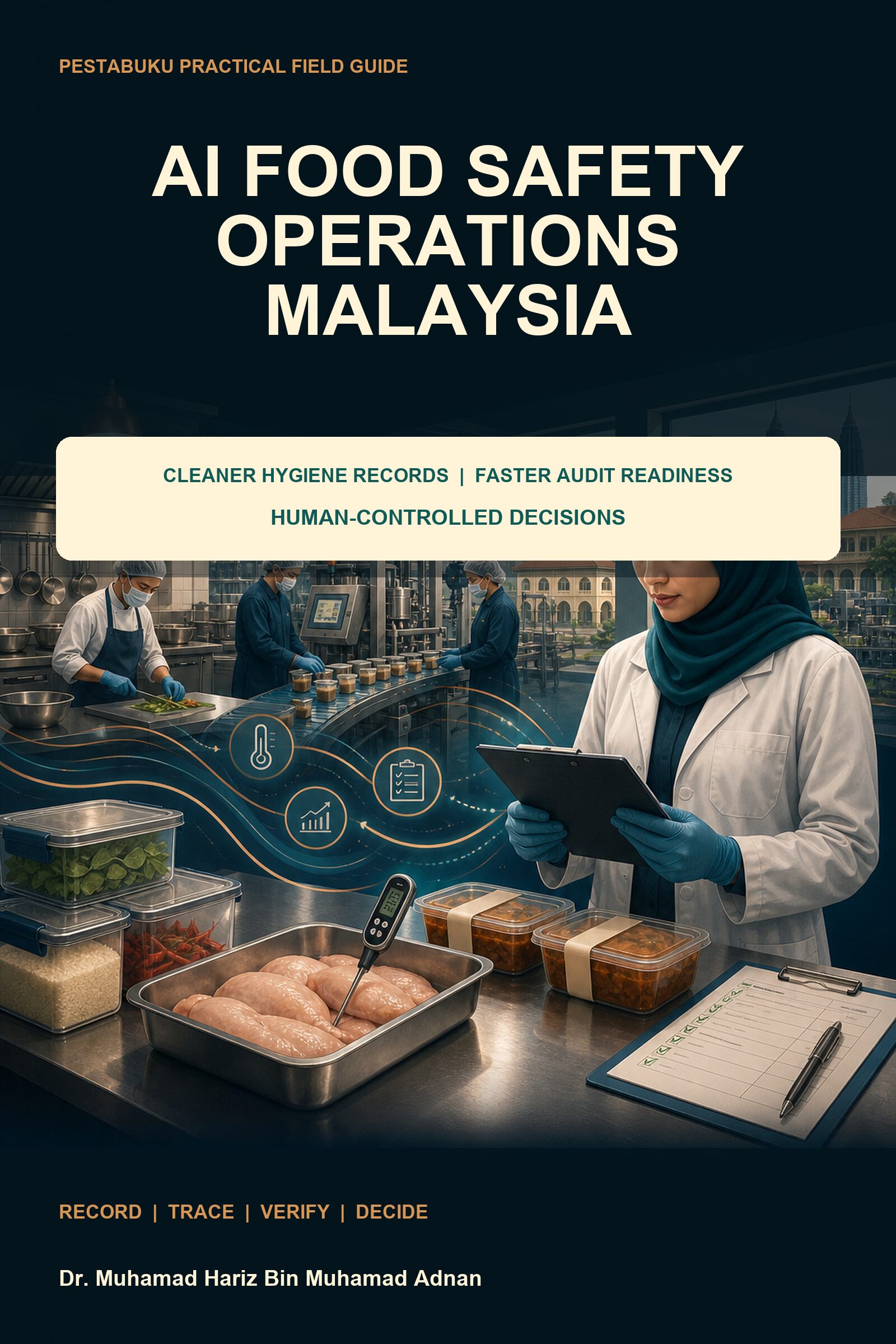
Get AI Food Safety Operations Malaysia for the complete 20-tool system, seven role playbooks, eight practical labs, troubleshooting clinics and fourteen-day rollout.
A safe prompt for missing-record detection
Use only an approved, minimum-data test set. A practical prompt contract is: “Compare each row with the supplied expected-record schema. Return record ID, missing field, rule ID and source location. Use UNKNOWN when evidence is absent. Do not infer readings, causes, compliance, safety or release. Keep original values unchanged.” Review every high-consequence field against its source.
Malaysian example: a central kitchen
A central kitchen combines receiving, chilled storage, preparation, cooking, cooling, packing and dispatch records. One weekly dashboard looks complete, but a delivery checkpoint uses a retired route code. AI flags the mismatch. Operations checks the approved contingency form, corrects the mapping and preserves the original. A second route has no evidence and remains HOLD. Similar-looking alerts therefore receive different outcomes based on source records.
Keep halal and food safety routes distinct
Halal assurance and food safety may share suppliers, cleaning records, traceability and change controls, but they are not substitutes. Maintain separate authority, applicability and approval decisions. A joined evidence index may reduce duplication while still showing which qualified role accepted each conclusion.
Protect people and confidential operations
Complaint, training, health, delivery and incident files may contain personal or commercially sensitive information. Follow the organisation’s privacy process and current Malaysian requirements. Remove fields unnecessary for the task, tokenise identifiers where appropriate, restrict access, log exports and keep the re-identification key outside the AI workspace.
Five gates before anyone acts
Gate 1: authority and scope. Gate 2: original records and traceability. Gate 3: approved criteria, instruments and verification. Gate 4: AI reproducibility, privacy and output challenge. Gate 5: unresolved issues and authorised human approval. Any critical HOLD or FAIL blocks the affected decision.
What AI can safely assist with
Appropriate pilot tasks are narrow and reversible. Examples include indexing controlled files, extracting explicitly labelled fields with source locations, checking whether required identifiers are blank, comparing an approved master list with received records, and grouping exceptions for human review. The organisation should test each task on a gold set and retain rejected outputs. A useful result says where the evidence came from and where it is missing.
Keep technical judgement outside the prompt. Do not ask the model to invent a hazard analysis, select a legal requirement, approve a supplier, diagnose a complaint, calculate a missing reading, decide a corrective action or release a batch. These decisions require current authority, process knowledge, competent review and accountable approval. If an AI answer could cause staff to continue work or release product, stop and redesign the task around evidence retrieval.
A seven-step small-business pilot
- Choose one premise, one product family and one low-consequence record family.
- Freeze read-only originals and create stable record identifiers.
- Define the expected schema, missing state and escalation owner.
- Remove names, contacts, addresses and other fields unnecessary for the task.
- Create synthetic good, bad, ambiguous and missing examples with expected results.
- Run the prompt, verify every source location and sample records the model did not flag.
- Document errors, restrict the rule, rerun the full pilot and obtain approval before routine use.
Measure more than speed. Record false positives, false negatives, reviewer effort, unresolved exceptions, data exposures and repeated corrections. A faster review that misses one significant exception is not an improvement. Begin with a small population and a clear stop condition, then expand only when evidence supports the change.
Before routine use, ask a second person to reproduce three source-to-output trails without coaching. They should be able to open the original record, see the transformation, identify the applicable rule and understand why the item passed, failed or remained on hold. Broken links, unexplained aliases and inaccessible files are control findings, not minor administrative issues. Repair the index and rerun the affected population.
Version the prompt, schema, mappings and exception rules together. A change to any one can alter results even if the model name stays the same. Give each release an effective date and preserve the previous version long enough to explain earlier decisions under the organisation’s retention rules. Never edit a rule in place and then present historical results as though nothing changed.
Corrective action must remain evidence-led
When the checklist finds a gap, first contain the affected decision under the approved procedure. Preserve original records, define the population, assign the investigation owner and separate facts from hypotheses. Correct the immediate issue, address the system cause and verify effectiveness on a later sample. AI may organise the timeline or draft neutral questions; it cannot decide that the action is sufficient.
Frequently asked questions
Can AI complete a missing food-safety record?
No. It may identify the gap, but creating a plausible reading or retrospective check would turn missing evidence into false evidence. Record the gap and follow the approved exception route.
Can AI decide whether a temperature exception is acceptable?
No. Preserve the reading, confirm instrument and time context, and route the case to the qualified role using the approved procedure. This article does not supply universal limits.
What should a small business pilot first?
Start with stable, low-consequence clerical work such as indexing controlled records or finding blank required fields in synthetic data. Measure false positives and false negatives before expanding scope.
How do I verify a generated checklist?
Map every item to a current official or controlled source, product and process. Remove generic items that do not apply, add missing local controls and have the authorised owner approve the exact version.
Official sources
- Ministry of Health Malaysia: Food Safety and Quality Programme
- MOH Food Hygiene Regulations 2009 reference page
- MOH GMP scheme page
- MOH HACCP scheme page
- Malaysia Personal Data Protection Commissioner
- NIST AI Risk Management Framework
Download the complete AI Food Safety Operations Malaysia ebook and use its worksheets to build a source-linked, human-controlled review system.