Halal Documentation Checklist Malaysia: 20 Checks Before Internal Review
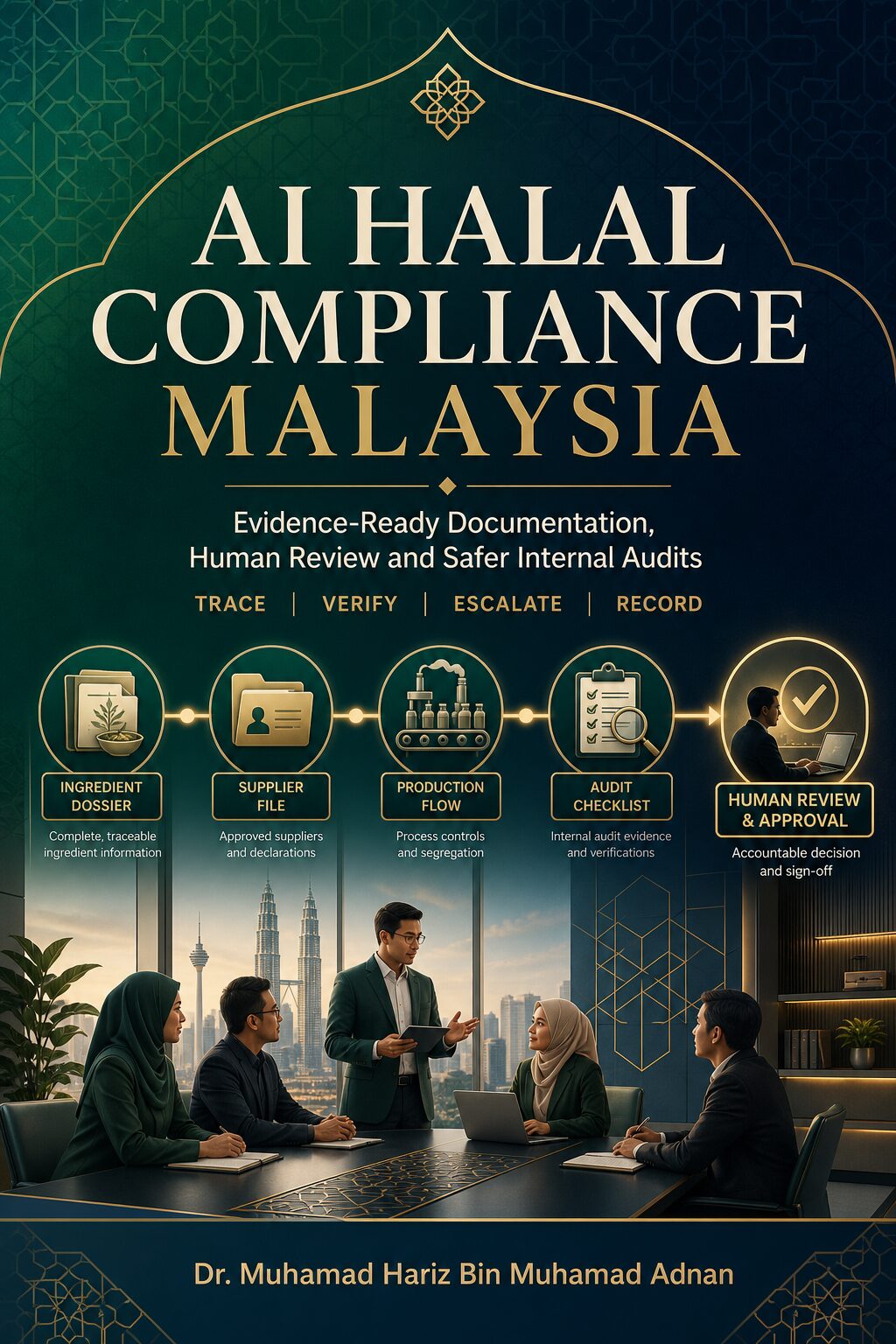
Early answer: A useful halal documentation checklist in Malaysia does not ask AI for a verdict. It checks that every product, ingredient, supplier, process, change and internal decision can be traced to current controlled evidence and a competent human owner.
Use the twenty checks below before an internal review or before deciding that a dossier is ready for the organisation’s authorised official process. The list is an independent operating aid, not a JAKIM, JAIN or MAIN form and not a guarantee of certification.
By Dr. Muhamad Hariz Bin Muhamad Adnan
Start with purpose, site and product scope
Write the exact internal decision: first review, renewal preparation, new product, supplier substitution, corrective action or another bounded purpose. Name the legal entity, premises, product codes, period, deadline and authorised reviewer. A conclusion for one factory or product code must not drift to a look-alike item, outlet or outsourced route.
- Record the internal purpose and prohibited AI outputs.
- List every product and premises included.
- Define change events that make the pack stale.
Check current official source authority
Build a source register from current official channels, including the Halal Malaysia portal and MYeHALAL route relevant to the organisation. Capture the document title, issuer, version or publication date, direct URL, retrieval date and competent applicability decision. Consultant slides, social posts and AI citations may help discovery but should not silently replace controlling sources.
Checks 1-3: source control
- 1. Every requirement row points to a retrievable official source location.
- 2. Superseded versions are marked and redirected.
- 3. Scheme, site and activity applicability is decided by a named human.
Trace ingredients beyond the consumer label
The ingredient ledger should include exact material code, trade name, manufacturer, supplier, function, current specification, sub-ingredients, carrier or processing aid where relevant, declared origin evidence, supporting document scope and validity. Cleaning chemicals, processing aids and contact materials may need controlled attention even when they are absent from the consumer ingredient list.
Checks 4-8: ingredient evidence
- 4. Code, manufacturer and grade match across recipe, specification and purchasing.
- 5. Compound materials have an approved route for deeper composition questions.
- 6. Missing origin or carrier information is UNKNOWN, not assumed PASS.
- 7. Critical documents are complete, legible, current for the relevant period and stored securely.
- 8. A competent reviewer owns every disposition.
Example: two suppliers sell an improver under similar names. Keep separate ledger rows until codes, manufacturers, sites and supporting documents prove the relationship. AI can highlight similar strings; it cannot decide that the materials are equivalent.
Test supplier files with four independent questions
Ask ENTITY, MATERIAL, SCOPE and TIME. Does the document identify the exact legal entity and site? Does it cover the exact material and code? Is its scheme and activity relevant? Was it valid for the receipt, production or review date? A cropped image, familiar logo or old transaction cannot answer all four.
Checks 9-12: supplier evidence
- 9. Manufacturer, distributor, importer and invoicing roles are separated.
- 10. The complete document and schedules are retained.
- 11. Purchase, delivery and receiving records link to the reviewed material.
- 12. Entity, address, site, code, formula or document changes reopen review.
Get the complete AI Halal Compliance Malaysia guide for RM9.99 for the full supplier test, ingredient ledger, change map, labs and human-release records.
Follow one lot through the real process
Choose one finished batch and trace backward to work order, issued material lots, receiving inspection and supplier evidence. Then choose one received lot and trace forward to storage, production, rework, finished goods and dispatch. Record quarantine, rejection, substitution and return as explicit statuses; do not rewrite the record to make the path look tidy.
- 13. Stable lot and work-order keys survive across systems and forms.
- 14. Quantity differences have tolerances and investigated explanations.
- 15. A timed trace can be repeated by someone other than the usual record owner.
Control every change before first use
A new supplier, manufacturer, ingredient code, recipe, process, site, OEM, label or claim can affect several records. Open one change request and map the ripple across product master, bill of materials, ingredient ledger, supplier file, process map, training, audit plan, artwork, old stock and effective date. Review the real implementation after the change.
- 16. All affected controlled records are identified.
- 17. Old and new versions have an explicit withdrawal or overlap rule.
- 18. A post-change sample confirms receiving, production and label use.
Use AI only inside a minimum-data evidence workflow
Good bounded tasks include indexing, field extraction, duplicate detection, comparison and drafting questions. Use an approved environment and the least data needed. Remove signatures, personal contacts, prices and proprietary composition when the purpose does not require them. Require source ID, quotation, location and UNKNOWN for absent fields.
Validate every critical field against the original. Keep an AI run manifest with purpose, tool context, input IDs, prompt, output, reviewer, errors and disposition. If the wrong file is uploaded or confidential data may be exposed, stop and follow the organisation’s approved privacy and security incident route.
Audit across risk, change and time
Define criteria and the complete population before selecting records. Include critical or complex materials, recent suppliers or recipe changes, different shifts, dates and previous findings. Triangulate documents with interviews and observation. A clean form does not prove that the physical process matched it.
- 19. Every sample has a written selection reason.
- 20. Every finding links criterion, objective evidence, control impact and an authorised response route.
Release through five gates
The internal pack passes authority, traceability, substance, human control and release gates independently. A critical FAIL or unresolved UNKNOWN means HOLD. The issued record shows the approved scope, date, reviewer, conditions, version, hash or equivalent integrity record, archive location and reopen triggers.
Fact-checking rule: retrieve current official sources immediately before use. Portals, procedures, laws and guidance can change. Do not quote a search result, chatbot answer or this article as if it were the controlling requirement.
Download AI Halal Compliance Malaysia for RM9.99 and implement the twenty tools, seven playbooks, eight labs, five release gates and fourteen-day plan.
Three Malaysian practice scenarios
Scenario one: a sauce manufacturer in Selangor. R&D proposes a new compound flavour from the current supplier. The commercial name is almost identical, but the manufacturer code and carrier statement differ. The correct workflow opens a new material row, preserves both specifications, asks focused composition questions, maps the recipe and artwork impact, and holds first use until the competent reviewer records a disposition. AI may compare the two documents, but it must quote each difference and return UNKNOWN for anything that is not stated.
Scenario two: a bakery in Penang. Procurement receives a certificate image through a distributor. The image shows an issuer and dates but not the complete product schedule. The team records the correspondence, requests the complete file, resolves the manufacturer-distributor relationship, and tests ENTITY, MATERIAL, SCOPE and TIME. The delivery remains under the authorised interim control. A familiar logo and a previous purchase are not used to fill the missing schedule.
Scenario three: a frozen-food plant in Johor. An internal audit samples one recent supplier change, one night-shift batch and one material linked to a previous finding. The auditor traces records, interviews the supervisor and observes storage. A form is complete, but the storage alias does not match the current material code. The finding states the criterion, objective evidence and control impact. Corrective action repairs the master-data route and later tests actual receipts; it is not closed on training attendance alone.
A safe extraction prompt pattern
Use prompts only in an approved environment with an input manifest. A practical pattern is: “Using only the supplied controlled records, extract the requested fields into the stated schema. For every value, return source ID, exact quotation and page or field location. If a value is absent, conflicting or unclear, return UNKNOWN and explain the conflict. Do not determine halal status, document authenticity, regulatory compliance or certificate validity. Do not infer composition, origin, scope or approval.”
Then provide the exact field schema, such as material code, manufacturer, site, supplier, document title, scope, issue date, expiry date and listed product. Validate critical fields fully against the originals. Record missed tables, footnotes, scanned text and naming ambiguities as error types. If the model cannot obey the quotation and UNKNOWN rules reliably, stop using it for that record class.
What to record before closing the review
The final internal record should identify the approved product and premises scope, source cut-off, open issues, competent reviewers, conditions, issue date, version and archive location. It should also name the events that reopen review: supplier or manufacturer change, new code, formulation or process change, different site, outsourced step, label or claim update, expired evidence, official-source change, audit finding or privacy incident. This closure discipline keeps an apparently finished pack from becoming an uncontrolled permanent truth.
Frequently asked questions
Can AI determine halal status?
No. It can assist with controlled evidence organisation and question drafting. Competent human decisions and applicable official processes remain essential.
Does a complete checklist guarantee certification?
No. A checklist improves internal evidence readiness but cannot guarantee or replace an official outcome.
What should happen when evidence is missing?
Record UNKNOWN, assign an owner and interim control, request focused evidence and escalate through the authorised route.
Official sources