How to Build an AI Training Plan for Employees in Malaysia
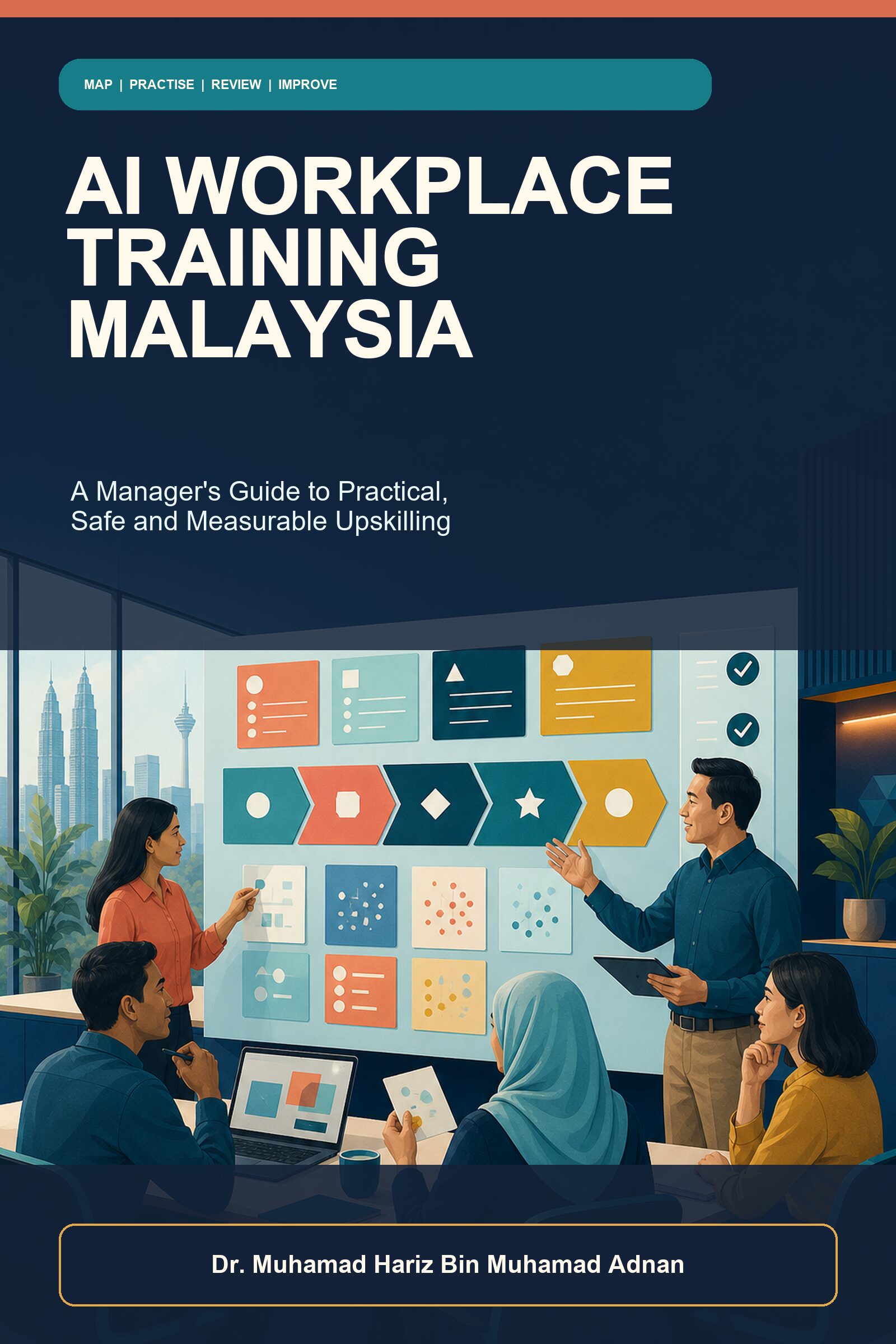
The short answer: an AI training plan for employees in Malaysia should begin with one role and one recurring task, then define approved practice data, observable success, manager review and a correction route. During training, use AI only to create reviewable drafts; do not let a model make employee, customer or safety decisions.
This checklist is designed for Malaysian managers and first-time internal trainers. It does not promise productivity, certification, funding or compliance. It gives you a repeatable way to plan, challenge, approve and correct workplace AI learning.
Before scheduling a session, assemble a training evidence pack: the selected work task, an approved example, a deliberately flawed example, synthetic practice cases, the organisation’s data boundary, English/Bahasa Malaysia terms, an accessible fallback, the observing manager and a simple baseline. If those items are missing, narrow the pilot before adding course content.
1. Start with Work, Not a Tool
Training earns its place when it improves a defined work task without weakening judgement, privacy, safety or accountability.
Common failure: Teams buy a course before agreeing which employee behaviour should change. The result is a feature tour that produces enthusiasm but no reliable transfer.
- Name the business need without a technology claim.
- Choose one role and recurring task.
- Describe an acceptable work product.
- Set non-negotiable boundaries.
- Assign the manager who owns transfer.
Malaysian example: A Shah Alam distributor chooses customer-enquiry triage as a first task. Staff practise classifying invented enquiries, draft options and check every commitment against the approved service guide; the supervisor remains responsible for the reply.
Stop rule: Do not promise productivity, savings or job transformation without a defined baseline and observed evidence.
2. Diagnose Roles, Tasks and Readiness
A credible needs analysis examines task frequency, difficulty, error cost, information sensitivity, available evidence and employee confidence.
Common failure: A generic survey asks whether staff are interested in AI, then treats curiosity as readiness for live use.
- Interview managers about observable work.
- Ask employees where effort and rework occur.
- Map task inputs and decisions.
- Score consequence and reversibility.
- Select a small mixed-readiness cohort.
Malaysian example: A Penang services firm maps quotation preparation. It separates public product descriptions from confidential pricing logic and selects only the public-description step for the first lab.
Stop rule: Do not infer competence, motivation or risk tolerance from age, title, accent or previous tool use.
3. Set Governance Before Practice
People learn safer habits when approved tools, data classes, review authority and correction routes are concrete parts of the exercise.
Common failure: A policy link is emailed before the course but no one rehearses how to apply it to a real input.
- List approved and prohibited environments.
- Classify realistic workplace inputs.
- Explain minimum necessary data.
- Define human approval points.
- Rehearse escalation and correction.
Malaysian example: A Johor Bahru clinic administration team uses fictional appointment messages. Trainers show why names, identifiers and medical details are unnecessary for learning tone classification.
Stop rule: Privacy and employment duties are fact-specific. This guide is educational and cannot determine compliance for an organisation.
4. Write Measurable Learning Outcomes
An outcome should name the work behaviour, conditions, quality criteria and evidence that a manager can observe.
Common failure: ‘Understand AI’ and ‘use prompts confidently’ are too vague to guide practice or evaluation.
- Write the workplace behaviour.
- State permitted conditions and references.
- Define quality criteria.
- Choose observable evidence.
- Set a review date for transfer.
Malaysian example: A Sabah logistics supervisor defines success as producing a draft delay notice from approved facts, with no invented timing and a source check completed before supervisor approval.
Stop rule: Do not grade personality, enthusiasm or writing polish when the outcome concerns evidence and safe process.
5. Design a Role-Based Curriculum
A compact curriculum moves from shared literacy to role-specific tasks, challenge practice and workplace transfer.
Common failure: Every employee receives the same examples even though consequences, language and information differ by role.
- Teach a common responsible-use foundation.
- Group tasks by role and risk.
- Sequence simple to consequential work.
- Add spaced retrieval and practice.
- Provide a non-AI route and refresh plan.
Malaysian example: A Klang SME runs a shared 45-minute foundation, then separate labs for sales follow-up, operations checklists and internal summarisation using role-specific evidence packs.
Stop rule: A curriculum should not authorise a use case merely because it can be demonstrated.
Need the full workflow? The AI Workplace Training Malaysia ebook includes 20 reusable templates, role playbooks, labs and a 14-day plan.
6. Build Safe, Realistic Practice Data
Practice material should feel like the job while remaining invented, de-identified or explicitly authorised and easy to correct.
Common failure: Sanitised examples are still identifiable when rare events, job titles and quotations point to a person.
- Identify the skill the data must expose.
- Create synthetic cases with realistic variation.
- Remove unnecessary identifiers.
- Plant known errors and ambiguities.
- Label every practice asset clearly.
Malaysian example: A Melaka retailer creates fictional customer questions with mixed English and Bahasa Malaysia, inconsistent product names and one unsupported delivery request so learners must ask for evidence.
Stop rule: Never use real personal, confidential or security-sensitive content merely to make a lab feel authentic.
7. Teach Prompting as Work Specification
A prompt is useful when it makes purpose, permitted context, constraints, output format, unknowns and reviewer responsibilities visible.
Common failure: Learners memorise magic phrases but cannot explain why an answer should be trusted or rejected.
- State the job and audience.
- Supply controlled context.
- Set exclusions and uncertainty rules.
- Request a reviewable output.
- Require self-check questions, not self-certification.
Malaysian example: A Kuching association asks for two event reminder drafts using only supplied dates, then requires the model to mark missing venue details instead of guessing.
Stop rule: A prompt cannot create authority, evidence, permission or professional competence that is absent from the workflow.
8. Teach Verification and Challenge
Verification is a learned performance: identify material claims, open the right source, inspect exact support and correct the work.
Common failure: Trainees are told to fact-check but are not shown what counts as a material claim or how to record evidence.
- Mark claims that could change action.
- Trace supplied facts to stable sources.
- Check dates, scope and definitions.
- Use counterexamples and negative cases.
- Record corrections and unresolved items.
Malaysian example: A Negeri Sembilan procurement team checks whether a generated summary preserves quantity, delivery location and validity date from an approved quotation pack.
Stop rule: Generated citations and search snippets are leads, not proof. Open the direct source before use.
9. Facilitate English and Bahasa Malaysia Practice
Bilingual facilitation protects meaning, participation and workplace usefulness when teams think and work across languages.
Common failure: The course translates slides but leaves technical terms, modal words and examples inconsistent.
- Choose the language for each activity.
- Lock controlled terms in a glossary.
- Explain certainty and obligation words.
- Let learners demonstrate in an appropriate language.
- Review meaning across versions.
Malaysian example: A Kota Bharu operations team distinguishes ‘boleh’, ‘perlu’, ‘mesti’ and ‘mungkin’ in AI-drafted safety reminders before any text can be approved.
Stop rule: High-stakes policy, safety and employment wording requires the approved source and competent review.
10. Run Inclusive Hands-On Sessions
Adults learn through psychologically safe practice, visible modelling, manageable cognitive load and useful feedback.
Common failure: Fast live demonstrations hide setup choices and embarrass learners who need more time, accessibility support or a non-AI path.
- Model the whole task slowly.
- Use private rehearsal before sharing.
- Pair evidence and challenge roles.
- Offer accessible formats and offline options.
- Debrief process rather than novelty.
Malaysian example: A Perak workshop provides printed case cards, keyboard-accessible files and paired roles so one learner drafts while another traces evidence; roles switch after feedback.
Stop rule: Do not force employees to disclose disability, language confidence or personal accounts to participate.
11. Coach Managers to Observe Transfer
Training transfer depends on manager expectations, time, feedback, approved access and a real task selected at the right risk level.
Common failure: Managers send staff to training but continue rewarding speed over evidence and correction.
- Brief managers before the course.
- Choose one transfer task.
- Observe behaviour with a rubric.
- Give corrective feedback without surveillance.
- Remove workflow barriers and review after two weeks.
Malaysian example: A Kuala Lumpur support lead observes whether agents separate known facts, unknowns and proposed wording; the lead does not score private chat style or keystroke speed.
Stop rule: Observation must be transparent, proportionate and tied to the stated learning purpose.
12. Measure Learning Without Invented Impact
Evaluation should separate participation, demonstrated skill, workplace transfer and business outcomes.
Common failure: Attendance, satisfaction and number of prompts are presented as productivity or return on investment.
- Record a pre-training baseline.
- Assess a comparable practice task.
- Observe a real transfer task.
- Track corrections and exceptions.
- Report outcomes with limitations.
Malaysian example: A Selangor administration team compares error types and review time on two similar fictional document-summary tasks, then runs a small approved workplace transfer check.
Stop rule: Do not publish savings, efficiency or accuracy claims unless definitions, comparison and evidence genuinely support them.
13. Run Five Training Release Gates
A five-gate workflow keeps the exact training package, practice data and facilitation plan reviewable before delivery.
Common failure: A slide deck is approved but later examples, links and exercises are added without the same checks.
- Gate 1: business purpose and role fit.
- Gate 2: sources and technical accuracy.
- Gate 3: data, rights and safety.
- Gate 4: language, inclusion and facilitation.
- Gate 5: exact-version approval and correction readiness.
Malaysian example: A Terengganu trainer blocks a session when an updated case accidentally includes a real customer reference, replaces it with synthetic data and reruns every gate.
Stop rule: A PASS applies only to the exact version, cohort, tool environment and date reviewed.
A safe training-lab prompt
You are supporting a workplace training exercise, not making a live business decision. Use only the fictional or explicitly approved case pack below. Produce two draft work products, mark every missing fact as [UNKNOWN], and list each statement the learner must verify against the supplied source. Then create a five-item reviewer checklist tied to the stated acceptance criteria. Do not infer a person's performance, authority or intent. Do not add Malaysian policies, prices, promises or tool capabilities that are absent from the pack.
Approve the training package through five named gates
- Business purpose and role fit: the exercise must teach an authorised work behaviour.
- Sources and technical accuracy: every material instruction and answer-key claim must trace to opened evidence.
- Data, rights and safety: the tool route, practice inputs, permissions and escalation path must be approved.
- Language, inclusion and facilitation: meaning, access alternatives and facilitator actions must work for the actual cohort.
- Exact version and correction readiness: reviewers inspect the learner-facing files, links and contact route that will actually be released.
Only an unconditional PASS at all five gates releases that exact version. Any unresolved condition is a FAIL that requires correction and rechecking.
Frequently asked questions
Can one AI course suit every employee?
No. Give everyone the same operational foundation for approved tools, data boundaries, verification and escalation, then use different task labs for each role. A finance administrator and a customer-service officer can share stop rules without sharing the same practice case or decision rights.
Which AI tool belongs in the training plan?
Use only an environment approved for the planned inputs and learning activity. Record the approval date and provide a paper-based or trainer-led equivalent so the learning outcome survives access problems and product changes.
How do I know whether the training transferred to work?
Ask the manager to observe one agreed low-risk task with the same rubric used in practice. Keep attendance, demonstrated skill, workplace behaviour and business results as separate evidence levels; a completed workshop is not proof of productivity.
Can real employee or customer data make the lab more realistic?
Realism does not justify unnecessary exposure. Build synthetic cases that preserve the task’s ambiguity and error patterns, label them clearly, and use real information only when the organisation has explicitly approved the data, environment and purpose.
When should the pilot stop?
Pause when the task owner cannot define acceptable work, the practice data or tool route is unapproved, learners cannot challenge the output, manager observation becomes covert surveillance, or a correction cannot reach affected people. Fix the condition before restarting.
Conclusion
A useful Malaysian employee AI plan is small enough to inspect: one role, one work task, safe cases, observable criteria, a manager check and five unconditional release gates. Expand only after the team can show what it verified, rejected and corrected without exaggerating results.
Get the complete AI Workplace Training Malaysia guide for RM9.99.
Author: Dr. Muhamad Hariz Bin Muhamad Adnan
Current direct sources
- AI Malaysia Berhad (National AI Office), Practical Guide to AI Governance and Ethics
- AI Malaysia Berhad (National AI Office), Learn AI
- AI Malaysia Berhad (National AI Office), AI at Work for Public Services 2.0
- TalentCorp, Jelajah AI MyMahir nationwide expansion
- TalentCorp, Impact Study of AI, Digital and Green Economy on the Malaysian Workforce
- HRD Corp, On-the-Job Training
- HRD Corp, Employers and training needs
- Personal Data Protection Commissioner, PDPA Act 2010 and current resources
- Personal Data Protection Commissioner, Frequently Asked Questions
- NIST, AI Risk Management Framework Resource Center
- NIST, Generative AI Profile
- Google Trends, FAQ about data