Business Plan Checklist Malaysia: Verify an AI-Assisted Plan Before You Share It
A useful business plan is not ready because the writing sounds professional. Before you share an AI-assisted draft, check whether every important claim is supported, every number can be recalculated, Malaysian context questions are current, and a named person owns the decision. The checklist below helps beginners find the quiet problems that polished prose can hide.
Run these checks on the exact file, data snapshot and financial scenario you intend to share.
This article is educational, not legal, accounting, tax, financing or investment advice. Requirements depend on the real business, activity, location, reader and current rules. Use current direct sources and qualified reviewers for consequential decisions.
Why an AI-assisted business plan needs a release checklist
Generative AI is useful for organising notes, proposing questions, comparing structures and producing a first draft. It is also designed to produce plausible language. That means it can complete a missing pattern with an invented market number, a generic customer profile, an old registration detail or a forecast that looks exact even when the inputs are weak.
Malaysia’s National AI Office presents responsible and ethical AI use as part of the management value chain. The practical lesson for a small team is simple: do not treat the model as the owner of the plan. Keep authority, evidence, calculation and correction with people.
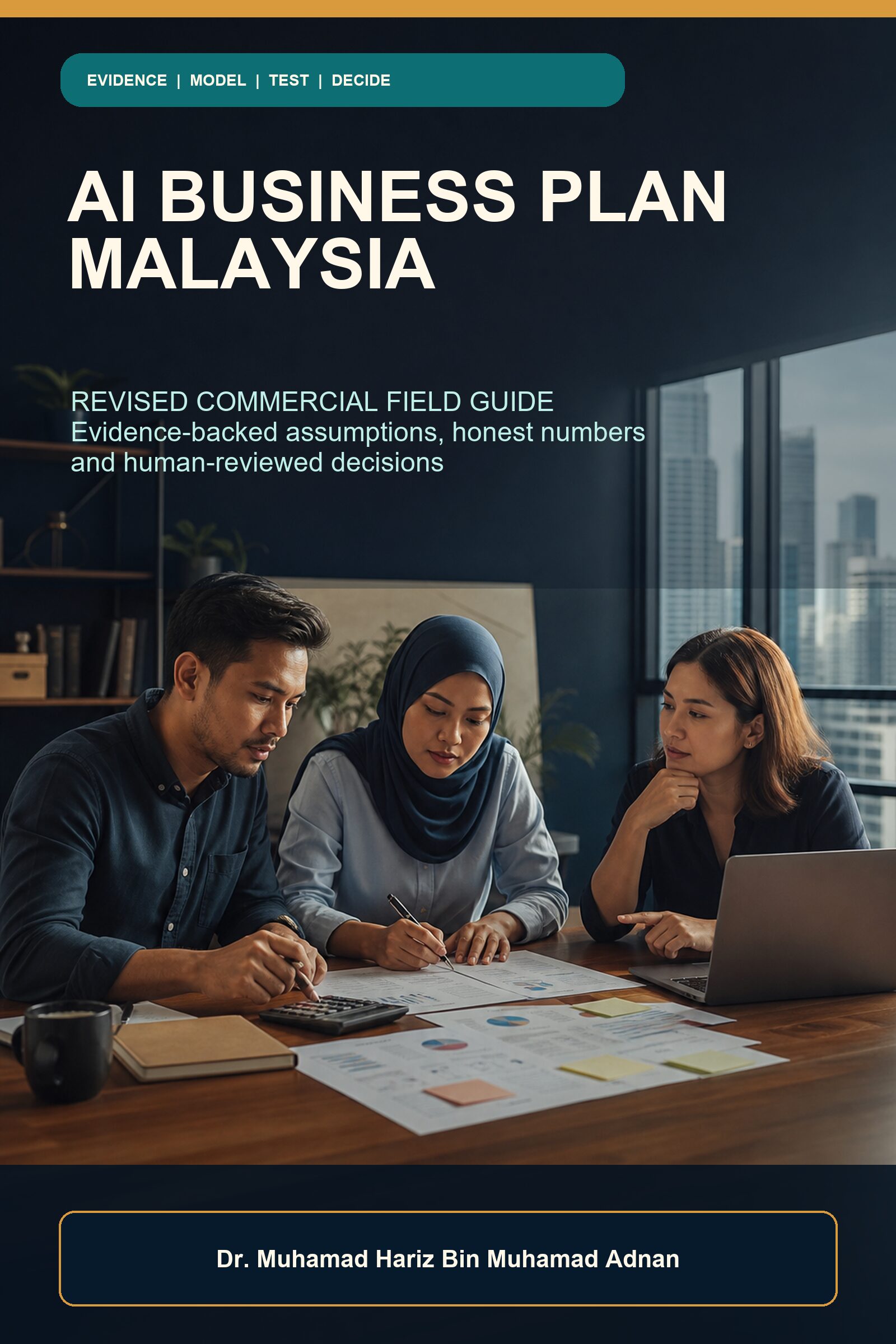
If you want the full step-by-step workflow, templates and guided exercises, see AI Business Plan Malaysia: Revised Commercial Field Guide. The live PDF ebook includes 20 reusable templates, six worked control rooms, six instructional diagrams and a 14-day practice plan.
Check 1: Is the reader and decision explicit?
Write who will read the plan and what decision it supports. A founder’s one-page operating plan, a university assignment, a partner discussion and a financing submission can use the same underlying facts but require different emphasis and evidence.
Record the reader, decision, owner, deadline, scope and non-goals. If the reader has a required template, obtain the current version directly. Do not assume a generic AI outline meets a bank, investor, programme or lecturer’s requirements.
Check 2: Can you label every material statement?
Mark each important statement as one of four types:
- Evidence: a dated fact from a traceable source or permitted research record.
- Assumption: something treated as true for planning but not yet established.
- Calculation: a result produced by visible inputs and a reproducible formula.
- Choice: a decision made by the accountable team.
If a sentence fits none of these, it may be filler or an unsupported claim. Delete it, find evidence or turn it into a question.
Check 3: Does each research claim have the right Malaysian definition?
A national statistic can explain context without proving demand for one offer. DOSM’s MSMEs Performance 2024 release, for example, reports national MSME economic contribution. It does not tell a founder how many people in one district will buy a new service next month.
For every market statement, record geography, population, period, unit and source. Separate the broad context from the first reachable customers. If the available source does not match the claim, say that the number is unavailable and design a smaller test.
Check 4: Are customer problems based on behaviour rather than an invented persona?
AI-generated personas often add age, income, motivation or family status because the profile sounds complete. Those details can be stereotypes rather than evidence.
Prefer recent-behaviour questions: What happened the last time? What steps did the customer take? Where did the process become difficult? What workaround did they use? What consequence followed? Keep disagreements and negative cases. A few supportive conversations do not represent all Malaysians.
Check 5: Are competitors and alternatives identified exactly?
Similar names, marketplace listings and search snippets can refer to different businesses. Build a fact card for each alternative with the exact name, domain, location, observable offer, published price or “not found”, source and retrieval date.
Do not treat a missing field as a weakness. It only means the information was not found in the checked public source. Do not copy a competitor’s wording, visual identity or protected expression.
Check 6: Can another person rebuild the unit economics?
Define one unit: one order, consultation, seat, workshop, item or subscription period. Then show price, direct costs, variable fees, fulfilment time, likely rework or wastage and the contribution formula.
Label every input as quoted, observed, assumed or calculated. Test low, base and high cases. If the model supplied a price or cost from memory, remove it until a current source or deliberate hypothesis exists. Important accounting and tax treatment needs appropriate professional review.
Check 7: Do operations and capacity support the sales story?
A plan can promise rapid growth while ignoring the people, time, equipment, supplier lead times and quality checks required to deliver. Map the route from customer request to completion. For each step, name the input, owner, time, capacity unit, quality check and common exception.
Stress the plan. What happens when a supplier is late, a founder is unavailable, demand arrives in one week, or rework increases? A responsible plan makes constraints visible instead of using words such as “seamless” and “scalable” without evidence.
Check 8: Are marketing and sales assumptions connected to measurable stages?
Views are not qualified leads, leads are not orders, and first orders are not retained customers. Define each stage in plain language. Show the audience, message, channel, action, follow-up, time lag, owner and measurement.
Use small experiments with budget and stop rules. Do not invent testimonials, endorsements, scarcity or performance outcomes. Follow current platform, advertising, consumer and organisational requirements.
Check 9: Are Malaysian registration and licence questions current?
SME Corp Malaysia describes a business plan as useful before starting and while operating. MalaysiaBiz provides information about registration and licensing, while SSM publishes current registration guidance. These are starting points, not a substitute for checking the exact business activity, structure, place and sector.
Turn legal and regulatory assertions into a question map: what must be registered, which licences or permits may apply, who is the responsible authority, what current page supports the question, and when qualified advice is required. Never label a generated paragraph as official approval.
Check 10: Has private, confidential and protected material been minimised?
Business-planning inputs can include customer records, employee details, supplier terms, unpublished ideas and financial information. Use only the minimum approved fields in an approved tool. Keep credentials, payment data, identifiable customer messages and confidential originals in protected systems.
The Personal Data Protection Commissioner publishes current guidance and the seven personal-data protection principles. MyIPO publishes copyright basics. Apply the real organisation’s policies and obtain qualified advice where needed; this checklist does not determine compliance or ownership.
Check 11: Do English and Bahasa Malaysia versions express the same certainty?
Back-check controlled names, dates, units, formulas, licence names and plan status. Words such as boleh, mungkin, akan, sasaran, unjuran, disahkan and diluluskan do not mean the same thing.
A scenario must not become a promise. A target must not become an approval. Ask a competent bilingual reviewer to explain the commitment level without seeing your intended meaning. If the explanation differs, revise before sharing.
Check 12: Has the exact final version passed five gates?
Evidence and calculation gate
Open every material source, check its date and definition, recalculate totals and compare the executive summary with the tables.
Privacy, security and permission gate
Confirm that inputs and outputs are permitted, minimised and stored in the correct place. Check licences and permissions for reused material.
Fairness, accessibility and language gate
Look for stereotypes, missing users, inaccessible formatting, unclear terms and changed certainty.
Business, financial and specialist-review gate
Ask the relevant operator, accountant, adviser or authority to review matters that exceed the team’s competence.
Release, version and correction gate
Record the exact file, reviewer, status, destination, owner and correction route. If any critical gate fails, keep the affected plan private.
A compact pre-share checklist
- The reader, decision, owner, scope and format are explicit.
- Claims are evidence, assumptions, calculations or choices.
- Malaysian facts use current direct sources and matching definitions.
- Customer and competitor statements preserve limits and unknowns.
- Unit economics, operations and scenarios can be reproduced.
- Marketing stages connect to measurable business outcomes.
- Registration and licence statements remain questions until verified.
- Private and protected material is minimised and authorised.
- English/Bahasa Malaysia certainty is consistent.
- The exact released version has an owner and correction route.
Conclusion
The best AI business plan is not the longest or most confident. It is the one a responsible person can trace, calculate, challenge, test and correct. Use AI to make careful work easier to organise, not to replace missing evidence or human judgement. Keep the evidence register current.
Ready for the complete workflow? Get the live RM9.99 PDF ebook, AI Business Plan Malaysia: Revised Commercial Field Guide, with 20 templates, seven Malaysian role playbooks, eight guided labs, six worked control rooms and a 14-day practice plan.
Official and primary sources
- SME Corp Malaysia: Planning Your Business
- DOSM: MSMEs Performance 2024
- MalaysiaBiz: Business Licensing Search
- SSM: EzBiz Online
- Malaysia National AI Office
- Personal Data Protection Commissioner: Introduction and Guidance
- MyIPO: Copyright Basic
- NIST: Generative AI Profile
Author: Dr. Muhamad Hariz Bin Muhamad Adnan