Event Planning Checklist Malaysia: 18 Checks for an AI-Assisted Event
Updated for Malaysia in 2026. A useful event planning checklist does more than remind you to book a hall and send invitations. It connects every promise to current evidence, an authorised owner, a practical guest route and a tested fallback. AI can help organise options, compare supplied information and draft controlled messages, but it cannot confirm a venue, sign a supplier, decide a safety response or guarantee turnout.
This 18-check guide is for Malaysian community organisers, SMEs, associations, educators, venue teams and freelancers planning a low- to medium-risk event. It is deliberately provider-neutral. Use approved tools, invented examples while practising, and your organisation’s current procurement, privacy, accessibility and incident procedures.
The 18-check event planning checklist
1. Write the event outcome before the programme
Describe the practical change the event should enable. “Participants can complete the new registration procedure and know where to obtain help” is reviewable. “Create an unforgettable experience” is not. Add outcomes outside your control, such as sales, attendance or weather, so a fluent draft does not turn ambition into a promise.
2. Record who may approve each commitment
Name the sponsor, budget holder, contract signatory, venue lead, data owner, communications approver and person who may pause or cancel. Mark every decision as proposed, approved or unavailable. This prevents a draft invitation from announcing a speaker, price or facility that nobody has authorised.
3. Match the exact venue, room and date
Use a room-and-date identifier on plans, photographs and notes. Confirm the setup used for capacity, access window, closing time, loading route, power, connectivity and venue restrictions. Old brochures and marketplace photographs are discovery aids, not proof of current operating conditions.
4. Walk the guest route
Trace discovery, registration, reminder, arrival, check-in, seating, programme, meals, help, departure and follow-up. At each point, ask what the guest must understand, do or wait for. Test a dead phone, a wrong room and a relevant access request. Provide a human recovery route for essential tasks.
5. Keep guest questions purposeful
Collect only information needed to deliver the event. Make appropriate access, dietary or communication questions optional, explain their purpose and give a private contact route. Do not infer disability, religion, food requirements or other sensitive traits from names, photographs or online profiles.
6. Compare vendors on the same scope
A cheap quotation may exclude setup, service time, tableware, transport, tax or overtime. Write a neutral requirement, retain the supplier’s direct documents and compare like with like. Mark status as discovered, contacted, clarification pending, approved or contracted. Never present a shortlist as a booking.
7. Build honest budget ranges
Separate fixed commitments from costs driven by attendance, duration or distance. Attach source and date to each material line, show inclusions and exclusions, and keep unknowns visible. Use low, base and high cases when quantities remain uncertain. An exact total assembled from assumptions is still uncertain.
8. Protect the practical timetable
Estimate content, questions, introductions, changeovers, movement, room reset, meals and prayer windows separately. Identify the critical path and remove optional activity before compressing protected needs. A shorter programme that can run is commercially stronger than a crowded schedule that depends on every transition being perfect.
9. Create one controlling run sheet
Every cue needs a clock time, trigger, action, owner, backup, communication channel and observable completion. Show dependencies across venue, stage, suppliers, registration and guest support. Freeze and distribute a version, then require acknowledgement for late changes. Obsolete private drafts should not compete on event day.
10. Verify access in the real setup
Inspect arrival, doors, gradients or lifts, seating, stage, toilets, signs, lighting, sound, digital information and the help route. Temporary furniture can break an otherwise workable path. Do not label an event accessible from a generic checklist; keep observed or authorised evidence for the exact arrangement.
11. Confirm food, prayer and quiet-space arrangements
Obtain menu, ingredient, preparation and service information from the responsible supplier. Use cautious language around cross-contact and certification, and train staff to refer questions rather than guess. Check that prayer or quiet space has appropriate access, privacy, signage, operating time and an accountable owner.
12. Minimise registration data
Challenge every field with: what event decision requires this information? Separate access by task so volunteers do not receive financial, identification or sensitive arrangement details. Define correction, retention and deletion routes before registration opens. The Personal Data Protection Commissioner publishes Malaysia’s official data-protection principles and current guidance.
13. Lock English and Bahasa Malaysia facts
Maintain one fact card for event name, date, time, venue, room, price, conditions and contact. Adapt natural phrasing in each language, then compare names, numbers, obligations, negatives and level of certainty. A competent reviewer should approve the exact versions guests will receive.
14. Give AI a bounded job
State the permitted sources, named output, unknowns, prohibited claims, reviewer and stop condition. Useful jobs include finding gaps in a run sheet, normalising supplied quotation fields or drafting options from an approved brief. Unsafe jobs include emergency decisions, invented supplier research, uncontrolled personal-data analysis or automatic publication.
15. Prepare disruption triggers early
List credible weather, transport, power, connectivity, supplier and crowd-flow failures. Link each to a direct information source, latest safe decision time, authorised owner, tested alternative and private message draft. For weather, use current official information from METMalaysia together with venue conditions; a forecast is an input, not a guarantee.
16. Run five release gates
Gate one checks purpose and authority. Gate two checks venue and suppliers. Gate three checks the guest route and access. Gate four checks data, rights and bilingual communication. Gate five rehearses the run sheet and contingency. All five must refer to the same version; a later material edit reopens affected gates.
17. Open a live control point
Keep the master run sheet, venue facts, contact route, issue log and backup materials together. Record observations separately from interpretations. Escalate safety, medical, safeguarding, security and technical issues through the authorised venue or specialist chain. AI should not generate emergency instructions during a live incident.
18. Close corrections, not just the event
After the programme, record public errors, unresolved guest issues, supplier follow-up and controls that failed. Name the owner and evidence required to close each item. Convert learning into a changed venue-pack field, contract check, run-sheet cue or rehearsal scenario; a celebratory summary alone does not prevent recurrence.
A practical AI prompt for a run-sheet review
Review the supplied final run sheet using only the attached venue facts, programme and responsibility list. Identify cues with no trigger, owner, backup, dependency or completion condition. Separate confirmed facts from unknowns. Do not invent venue rules, safety procedures, supplier status, prices or guest information. Return a correction table for the operations lead to approve.
Before use, remove unnecessary personal or confidential information. Keep the source files, generated output, corrections and release decision so another authorised person can reproduce the reasoning.
What to verify with current official sources
Malaysia’s National AI Office describes its AI governance guidance as a general guide for responsible adoption and risk-reward assessment; it does not replace applicable requirements. The Personal Data Protection Commissioner provides current principles and guidance for personal data. METMalaysia provides official weather information, while MyCEB is a useful official reference for Malaysia’s business-events ecosystem. Venue, supplier and local operating conditions still require direct confirmation for the specific event.
- Malaysia National AI Office: Practical Guide to AI Governance and Ethics
- Personal Data Protection Commissioner: Principles of Personal Data Protection
- METMalaysia: district weather forecast
- Malaysia Convention and Exhibition Bureau
Frequently asked questions
Can AI plan the whole event?
No. It can structure supplied information and create reviewable options. Humans with real authority must confirm venue, contracts, budget, accessibility, personal data, communications, safety and live correction.
Which AI tool should an organiser use?
Use a currently approved tool whose controls fit the permitted inputs. Choose by the job and the organisation’s data rules rather than popularity. Keep a non-AI process for critical records and live operations.
Can I upload the registration list?
Do not assume that is permitted. Confirm the purpose, deployment, access and organisational approval first. Many planning tasks can be completed with invented examples, aggregated counts or a reduced operational view.
Does this checklist guarantee a successful event?
No. It improves traceability and preparation but cannot guarantee attendance, weather, supplier performance, venue conditions, safety or commercial results. Important decisions still require current evidence and accountable review.
What should a small team prepare first?
Begin with four compact records: an outcome-and-authority card, a dated venue fact register, a simple guest journey and one controlling run sheet. Those records expose most hidden assumptions before the team spends time polishing invitations or decorative concepts. Add supplier, budget, access, privacy and disruption tools as the decisions become real. Keep the system proportionate: a community workshop does not need the same production structure as a multi-room convention, but both need clear ownership and a way to stop unsupported promises.
Use the full commercial field guide
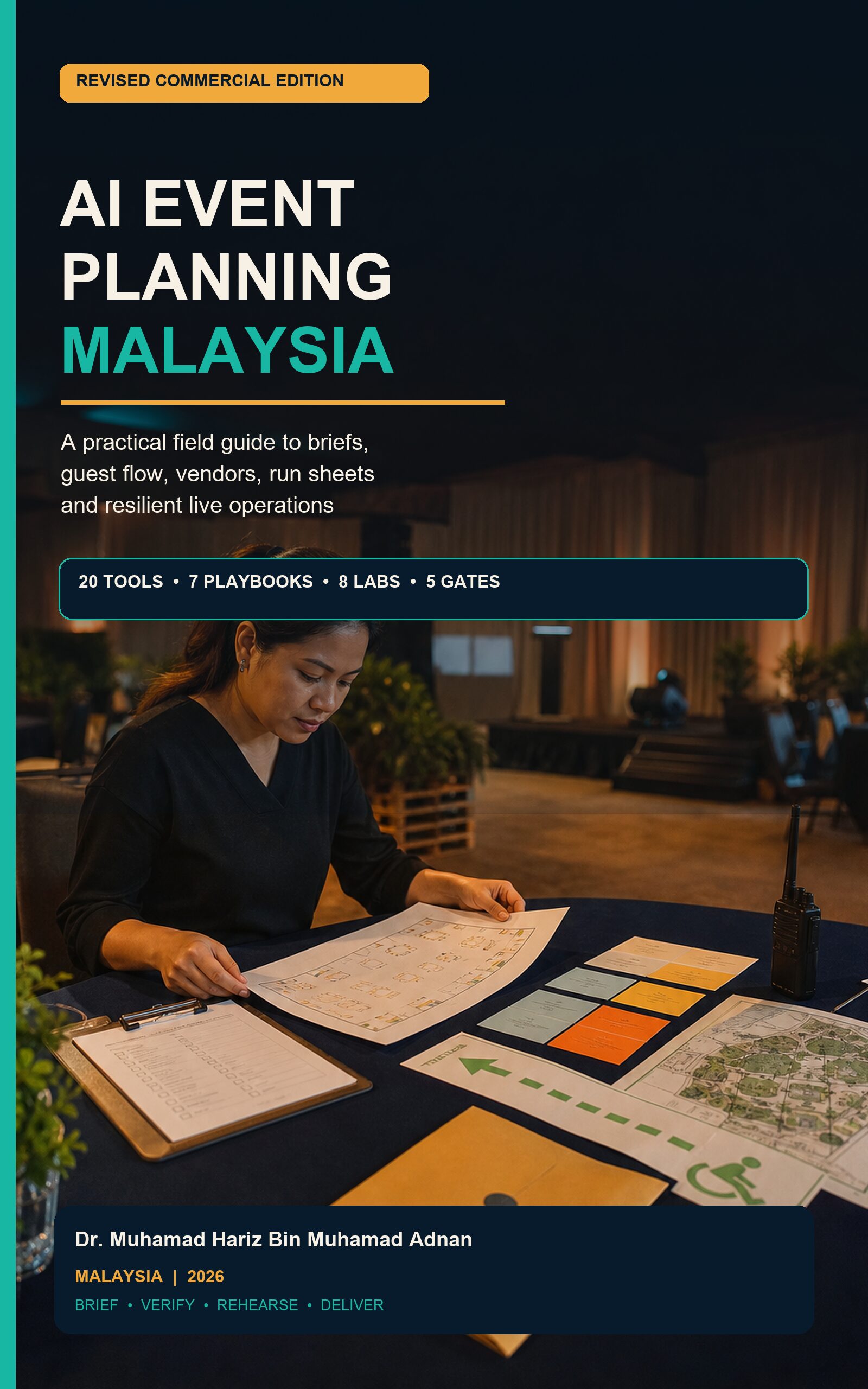
The revised ebook expands this checklist into 20 reusable event tools, seven Malaysian role playbooks, eight labs, six control-room examples, 20 bounded prompt recipes, six instructional visuals and a 14-day practice plan. View AI Event Planning Malaysia: Revised Commercial Field Guide for RM9.99.
Final reminder: verify current facts, minimise data, keep unknowns visible and release only the exact version approved by the responsible people. Get the searchable PDF and its complete five-gate workflow.