How to Plan a Customer Service Chatbot for a Malaysian Small Business
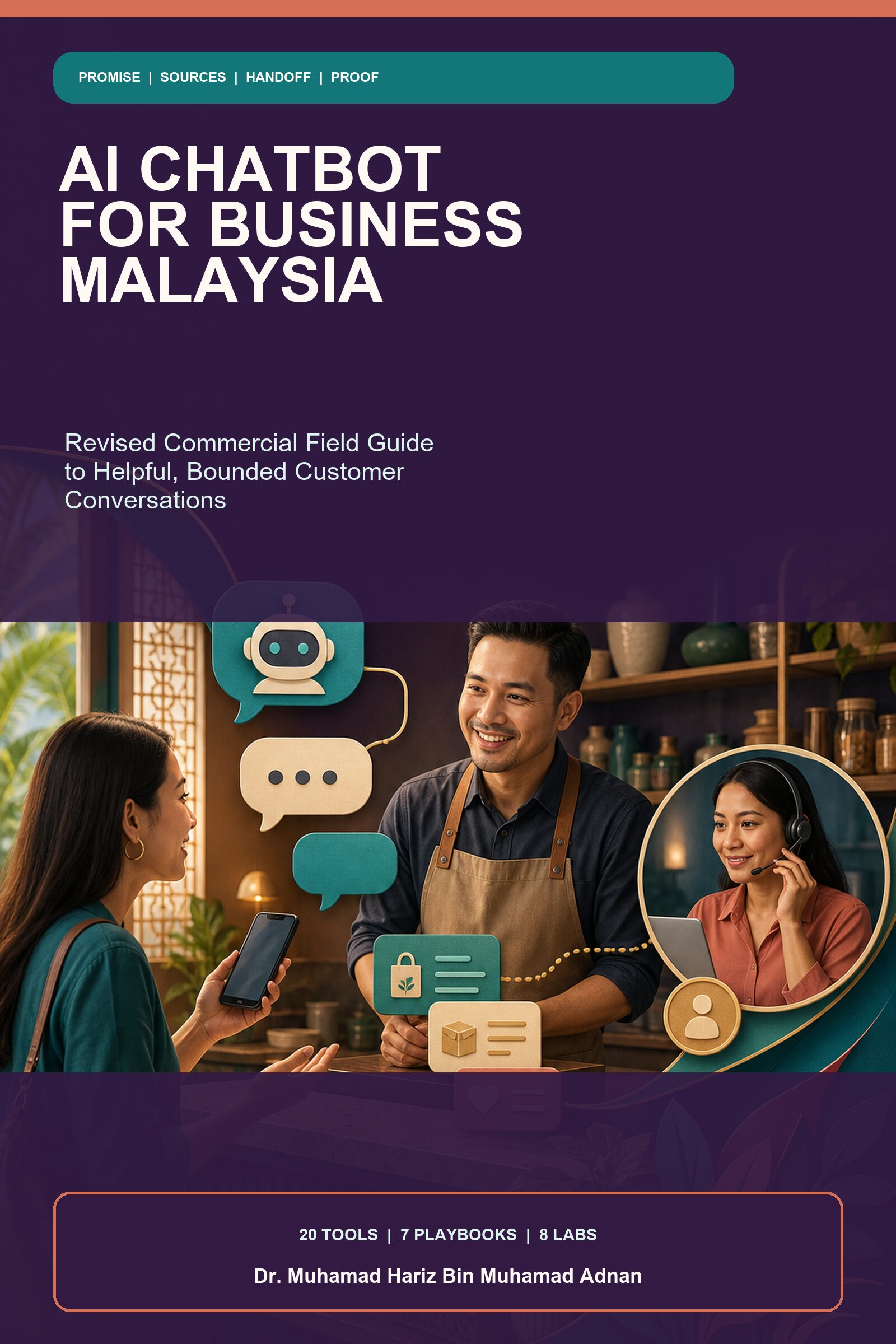
A small Malaysian business should plan a customer-service chatbot by starting with one low-risk customer task, not a software demo. Define what the assistant may answer, give it current approved sources, make human help visible, test normal and difficult cases, and launch only a limited pilot that the team can monitor.
This approach works whether you later choose a website assistant, a messaging channel, a no-code platform or a custom system. The technology may change. The service questions remain: What does the customer need? Which source supports the answer? Where must automation stop? Who takes over? What evidence proves the experience is useful?
Why customer-service chatbots need a Malaysian service plan
Malaysia has visible examples of organisations using bounded AI enquiry channels. The Companies Commission of Malaysia says its Biz AI service initially handles questions related to the Registration of Businesses Act 1956. That limited initial knowledge area offers a useful lesson for any beginner: a clear scope is more credible than a promise to answer everything. See the official SSM Biz AI page.
A local small business may want to answer delivery, programme, appointment or venue questions. Those can be reasonable first tasks when the information is public, stable and owned. A chatbot should not quietly expand from providing information to approving refunds, changing accounts, diagnosing a problem, promising availability or exposing customer records.
The Malaysia National AI Office describes responsible AI governance in terms that include privacy, bias, accountability and transparency. Its learning material highlights seven principles including fairness, reliability and control, privacy and security, inclusiveness, transparency and accountability. A useful pilot turns those principles into practical checks rather than placing them in a disclaimer. Read the NAIO governance page and NAIO learning page.
Step 1: Choose one customer outcome
Write the task from the customer’s point of view. “Delivery” is a topic. “Check whether standard delivery covers my postcode” is an outcome. “Tuition information” is broad. “Find the current public schedule and registration steps for the beginner class” is testable.
Use a simple filter:
- Green: stable, public and reversible information such as opening hours, public venue details or a document checklist.
- Amber: exceptions, personal context, changing rules or judgement. The chatbot can explain general information and route to a person.
- Red: emergencies, high-consequence advice, identity or security actions, sensitive allegations and unauthorised decisions. Do not let the chatbot decide.
A homestay assistant might explain published check-in hours but should not guarantee early check-in. A tuition-centre assistant might show a public timetable but should not assess a child’s needs. An online shop assistant might explain the return policy but should not approve an exception without the authorised process.
Step 2: Build approved answer cards
Before configuring AI, create a small answer library. Each card should contain the customer intent, approved short answer, conditions, required clarification, claims to avoid, direct source, effective date, owner and human route.
If three pages show different prices or service hours, do not ask AI to choose. Resolve the conflict. A chatbot inherits the quality of its knowledge. Temporary promotions need expiry dates, and every live source needs an owner.
A good answer card also prevents a common failure: losing conditions while making an answer shorter. “Processing normally takes three business days after complete documents are received” should not become “ready in three days.”
Step 3: Make the human route part of the design
Customers should not have to argue with automation to find a person. The opening message should identify the assistant as automated, name the tasks it supports, warn against sharing prohibited data and show the human-contact option.
A useful handoff defines:
- the trigger, such as a customer request, repeated failure, unsupported task or sensitive matter;
- the receiving team and actual service hours;
- the minimum summary transferred;
- what the customer should expect next, using approved wording; and
- a fallback when the queue or integration is unavailable.
Do not write “someone will reply soon” if the organisation has no approved response expectation. Honest service hours build more trust than an invented promise.
Before launch, rehearse the handoff with the receiving staff member. A ticket can be created successfully yet still fail the customer if no one owns the queue, the summary lacks the essential question or the customer is asked to repeat everything. Test the main route, an out-of-hours request and a simulated queue failure.
For the complete 77-page field guide with answer-card, handoff, bilingual glossary, test, incident and vendor-review tools, see AI Chatbot for Business Malaysia: Revised Commercial Field Guide.
Step 4: Test meaning, boundaries and failure
A polished demo is not a quality test. Build a golden set with direct questions, paraphrases, typos, short chat-style phrases, Bahasa Malaysia, English, mixed-language input, missing details and out-of-scope neighbours.
For each case, record expected facts, conditions, source, prohibited claims and handoff. Weight failures by consequence. A data exposure, unauthorised action, dangerous instruction or broken required handoff is critical and should block release. It cannot be averaged away by many correct greetings.
Mini chatbot test checklist
- Does every factual answer match a current source?
- Are conditions, dates, currency and units preserved?
- Can the customer reach a person immediately and after failure?
- Does the assistant ask only for necessary information?
- Do approved BM, English and mixed-language cases preserve the same meaning?
- Does an unsupported question produce a clear limitation rather than a guess?
- What happens when the source, model or human queue is unavailable?
- Can a user instruction override access or reveal another conversation?
- Can an authorised owner disable the affected intent quickly?
OWASP explains that prompt injection can manipulate model behaviour and that retrieval or fine-tuning does not fully remove the risk. It recommends layered controls, least privilege and human approval for high-risk actions. Review the current OWASP prompt-injection guidance and sensitive-information guidance.
Step 5: Minimise data and launch a limited pilot
If a postcode is enough to check general delivery coverage, do not ask for a full address. If a public timetable answers the question, do not ask for a learner’s name. Use synthetic data during early testing and keep production credentials outside model instructions and source files.
Malaysia’s Personal Data Protection Department summarises seven principles under Act 709, including notice and choice, disclosure, security, retention, data integrity and access. Apply the current law and appropriate professional advice to the real data flow; a generic checklist cannot determine whether a specific deployment is lawful. Start with the official personal-data principles and Personal Data Protection Standard 2015.
A limited pilot should name the audience, channel, hours, intents, duration, staff owner, monitoring sample, stop conditions and rollback method. Review correctness, customer effort, handoff quality, source freshness, language and safety together. Do not treat a conversation ending without a person as proof of success; the customer may have abandoned it.
Common planning mistakes
Starting with the biggest knowledge upload
More files create more conflict and maintenance. Begin with five to ten owned intents and current answer cards.
Hiding the human option
Containment is not helpful when a customer needs an exception or simply prefers a person. Make handoff visible from the start.
Letting a model confirm an action
A sentence is not a transaction result. A booking, refund or account change requires authenticated systems, deterministic validation, appropriate permission and verified confirmation.
Claiming bilingual support after one test
Maintain an approved glossary and representative BM, English and mixed-language regression cases. Test meaning, especially words such as estimate, confirmed, cancellation and refund.
Measuring only volume
Conversation count does not show whether answers were correct or customers succeeded. Review representative transcripts lawfully, conditions, handoffs and incidents.
FAQ
Do small businesses need coding skills to start?
No. A team can define scope, build answer cards, map journeys and run spreadsheet tests without code. Secure integrations, custom access controls and production monitoring may need qualified technical support.
Should the chatbot pretend to be human?
No. Disclose that it is automated. A warm tone is compatible with transparency.
Can a chatbot eliminate wrong answers?
No credible workflow should promise zero error. Narrow scope, current sources, deterministic controls, testing, handoff and monitoring reduce risk. Important facts still need verification.
What if the best result is not a chatbot?
Use the better page, form, search feature, live chat or staff answer library. Responsible planning includes the decision not to deploy AI.
Build the evidence before the launch
A useful Malaysian customer-service chatbot is not defined by its personality. It is defined by a customer promise the business can keep, sources the team can maintain, boundaries the system enforces, a human route that works and evidence that difficult cases fail safely.
Ready to build the complete pilot package? Get the AI Chatbot for Business Malaysia Revised Commercial Edition, a 77-page downloadable PDF by Dr. Muhamad Hariz Bin Muhamad Adnan with 20 reusable tools, seven Malaysian playbooks, eight guided labs, six instructional diagrams, five release gates and a 14-day plan.
AI output may be incomplete, outdated, biased or wrong. Verify important facts against current primary sources. This article is educational and is not legal, privacy, security, medical, financial or other professional advice.
Start narrow, test difficult cases, and keep a responsible person in control.