Social Media Content Calendar Malaysia: A Practical AI-Assisted Workflow
A useful social media content calendar for a Malaysian business is not a grid of random ideas. It is a small operating system: every post answers a recognisable audience question, uses approved evidence, fits the team’s capacity, passes human review and has a clear correction route. AI can help sort questions, propose structures and create private options, but it should not decide which claims are true or which version is safe to publish.
This workflow is platform-neutral because channel features and policies change. Start with the audience decision and the evidence you control, then check current first-party requirements for the exact surface you use. No posting frequency, reach result or sales outcome is guaranteed.
1. Write the audience decision before the posting schedule
Replace broad goals such as “increase engagement” with a situation a person is trying to resolve. A Shah Alam home baker might help parents decide which cake size fits a gathering and what to ask before collection. A Johor repair service might help customers prepare model details and symptoms before requesting a booking. These are useful jobs the team can support without promising that a post will go viral or cause a sale.
Write one sentence containing the audience, situation, uncertainty and next useful action. Then name the business job: reduce repeated confusion, prepare customers for a service, explain a comparison or direct an account-specific case to the correct route. If a proposed post has no audience decision, do not ask AI to make it sound exciting; remove the slot.
2. Build a permitted evidence pack
Before drafting, gather current product facts, opening hours, delivery areas, approved frequently asked questions, owned photographs and direct official sources. Give important facts stable IDs, owners and last-checked dates. Separate confirmed facts from estimates, opinions, hypotheses and unknowns.
This matters because generated copy often fills gaps with plausible benefits, prices, features, statistics or testimonials. A polished sentence is not proof. For each material claim, open the direct source and confirm that it supports the exact wording. Malaysia’s National AI Office frames responsible AI as a human-centred, accountable practice; its Practical Guide to AI Governance and Ethics is a useful current reference for organisational controls.
3. Give each channel a specific job
List only the channels the team can maintain. Assign each one a verb-led role such as discover, compare, prepare, ask, register or obtain support. An owned article may hold the full explanation; a short post may surface one decision; a message route may handle account-specific questions. The facts and limitations stay consistent, but the format and depth can change.
Check the channel’s current first-party rules for links, dimensions, captions, advertising and disclosures. Record the date. Memory is not a stable source for a changing platform. A channel that adds no distinct job consumes research, design, review and response time, so pausing it may be the responsible choice.
4. Turn questions into evidence-backed pillars
Collect real, de-identified questions from approved FAQ logs, search records, sales notes and staff observations. Group them by the decision they support: understand, compare, prepare, use, troubleshoot or seek help. Let those clusters shape the pillar names.
Attach proof to every pillar. A Klang repair shop might use symptoms, safe basic checks, booking preparation and maintenance as pillars because it has current sources and qualified review. It should not diagnose hazardous faults in comments or infer private traits from follower behaviour. Generic labels such as “education, inspiration and promotion” remain too weak until they name an audience job and evidence path.
5. Budget the real production workload
AI can populate a month in seconds, but the team still needs time for research, writing, bilingual review, design, accessibility, approval, scheduling and replies. Estimate those stages. Add fixed business dates, review cut-offs and a few recheckable evergreen posts for delayed campaigns.
Choose a minimum viable cadence that the team can support. Empty space is not failure. A full calendar with zero hours for factual review or customer response is less commercial than a smaller plan with reliable information and clear ownership.
6. Brief one post before generating options
A reviewable post brief should state the audience moment, one approved message, fact IDs, format, language register, visual plan, CTA, prohibited claims, accessibility needs and stop conditions. Move those decisions into the shared record rather than leaving them inside a chat.
Bounded drafting prompt: Using only the supplied fact IDs, create three structurally different caption options for this audience decision. Preserve every limitation and date. Mark missing evidence as UNKNOWN. Do not invent a source, price, feature, quotation, testimonial, permission, policy or result.
Review the smallest useful draft first. If the brief is incomplete, ask questions or return to the evidence pack instead of allowing the model to complete the story.
7. Review bilingual meaning, not just vocabulary
Decide which language carries the approved source meaning. Maintain a working glossary for product terms, local phrases, register and words to avoid. Adapt the second version naturally for the audience, then compare names, numbers, dates, negatives, conditions, certainty and the requested action.
English and Bahasa Malaysia versions do not need identical sentence structure. They do need materially consistent claims and limitations. Use a competent reviewer who understands the subject and the intended Malaysian audience; fluency alone is not approval.
8. Protect originality, accessibility and personal data
For visuals, define the communication job before the style. Use owned or properly authorised assets, describe composition and hierarchy, and avoid requests to imitate a recognisable creator or competitor campaign. Reject generated imagery that changes product colour, material, scale or other important detail.
Keep essential information in accessible text where possible. Provide meaningful alternatives for informative images, accurate captions for audio and video, and readable contrast and type on a small screen. The W3C Images Tutorial explains that alternatives should communicate the information or function of the image; decorative images can use an empty alternative.
Map personal data before it enters a prompt, design file, scheduler or analytics record. Prefer invented or aggregate examples. Malaysia’s Personal Data Protection Commissioner summarises principles including notice and choice, disclosure, security, retention, integrity and access on its official principles page. Obtain qualified advice for the organisation’s exact duties.
9. Run five release gates
- Audience value: the post supports a named decision and legitimate business job.
- Evidence and claims: material wording traces to current approved sources, uncertainty is visible and disclosures were considered.
- Rights, language and inclusion: assets have provenance, composition is original, bilingual meaning is reviewed and accessible alternatives are ready.
- Privacy and response: data is minimised, the tool route is approved and higher-risk replies have a hand-off.
- Operations and live state: the exact version is approved, the scheduler matches and the public CTA, image, copy and correction route work.
Freeze the caption, media, alt text, CTA and disclosure under one version ID. If any material element changes, repeat the affected gate. Approval belongs to an exact artefact, not to a vague campaign.
10. Learn without claiming causation
Choose measures that relate to the audience job: qualified FAQ visits, completed registrations, better-prepared enquiries or fewer repeated service questions. Record the baseline, publication dates, promotion, inventory, landing-page changes and outages.
Describe what changed, then list alternative explanations and unknowns. A reach increase does not prove AI or a posting time caused the result. Decide one bounded next test and protect accuracy, service quality and audience trust from being crowded out by vanity metrics.
A practical next step
Build one four-week calendar for a single audience decision. Keep the question bank, fact register, brief, human corrections, approved version, live URL and learning note. That evidence trail is more valuable than a folder of captions nobody can explain.
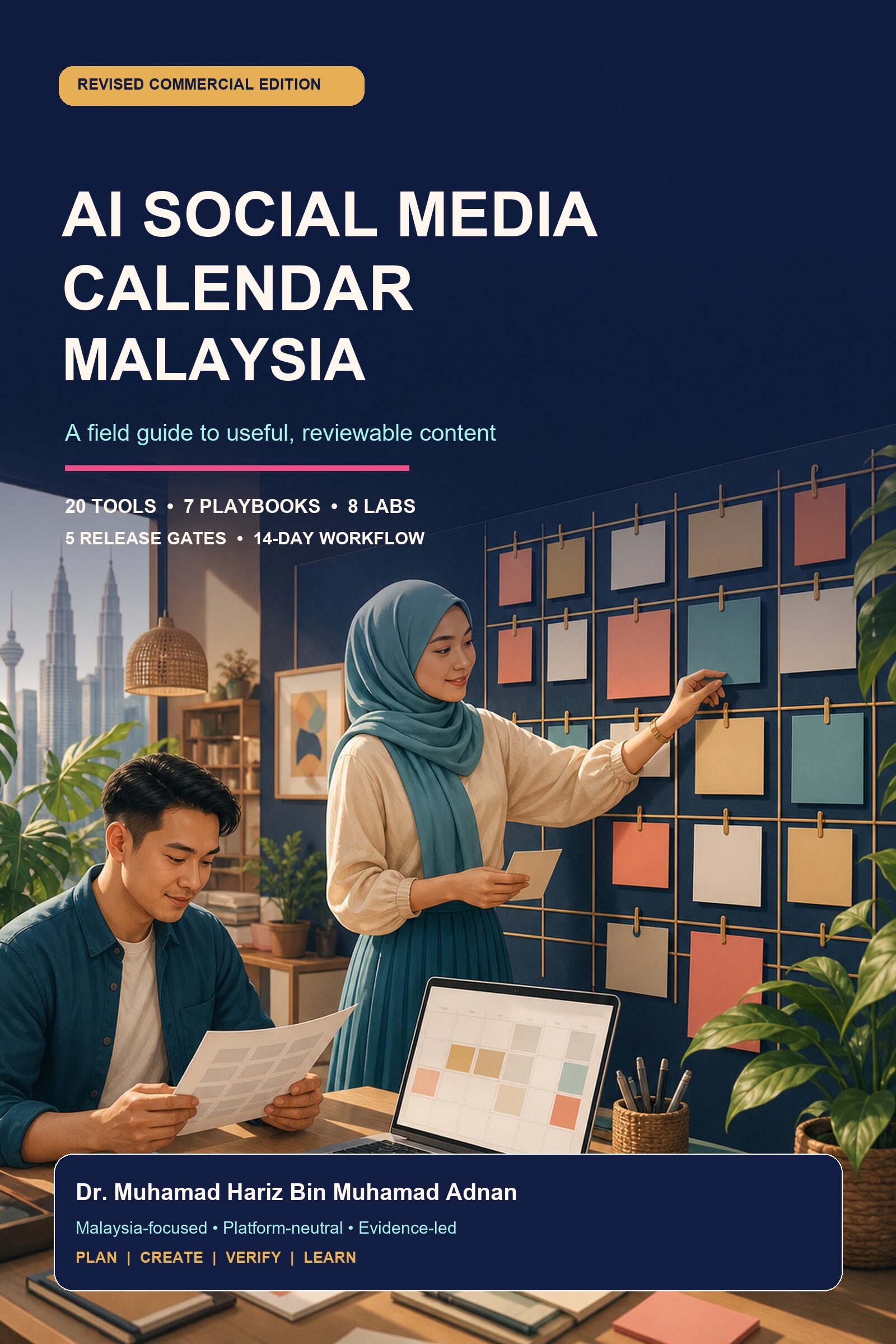
For the complete system—including 20 reusable tools, seven Malaysian role playbooks, eight practical labs, six worked control rooms, bounded prompt recipes, troubleshooting and a 14-day implementation plan—see AI Social Media Calendar Malaysia: Revised Commercial Field Guide.
Frequently asked questions
Can AI create the whole calendar automatically?
It can propose private options, but a person must define the audience job, supply permitted evidence, review meaning and rights, approve the final version and support corrections.
How often should a small Malaysian business post?
There is no universal number here. Choose a frequency the team can research, review, publish and respond to consistently, then adjust from documented learning.
Should every post be bilingual?
Use audience need and channel context. When two versions are produced, protect material meaning and obtain competent review for the named audience rather than translating word for word.
What if a published post is wrong?
Contain further spread, preserve controlled evidence, correct connected surfaces, verify the public result and repair the workflow that allowed the error. Use authorised incident or professional routes where required.
Ready to turn the checklist into a repeatable operating system? Get the full AI Social Media Calendar Malaysia Revised Commercial Field Guide for RM9.99.
Educational information only. AI output may be incomplete, outdated, biased or wrong. Verify consequential facts and decisions with current direct sources and authorised reviewers.