How to Write Product Descriptions with AI: A Safe Malaysian Workflow
By Dr. Muhamad Hariz Bin Muhamad Adnan
Short answer: To write a product description with AI, first build a verified fact sheet, separate features from benefits and proof, use a closed-source prompt, and run human quality checks before publishing. The model should draft from approved facts; it should not invent specifications, results, reviews, urgency or policy.
For Malaysian online sellers and small businesses, the most useful AI workflow is not ‘one prompt and publish’. It is a controlled path from the real product to a reviewable draft and a tested live page. That matters because fluent AI output can still be incomplete, outdated or wrong, and because marketing copy may affect money, expectations, privacy and trust.
Start with a verified product fact sheet
Before opening an AI tool, list the exact product name, final file or physical specifications, intended user, inclusions, exclusions, requirements, delivery process, licence or use conditions, evidence and owner. This fact sheet is the boundary. A model should not fill gaps from what similar products usually contain. Mark missing information as a question for the product owner. For a digital item, open the final customer file and verify format, page count, size, software requirements and what the buyer actually receives. For a service, verify scope, client responsibilities and what happens after enquiry or payment.
Separate features, benefits and proof
A feature is an approved fact. A benefit is a cautious explanation of why that fact may matter to the intended buyer. Proof is the material that supports an important statement. Keep all three visible in a table before drafting. If a feature is 'editable DOCX and PDF', a reasonable benefit may be easier adaptation and sharing, but only if both files are truly delivered and the licence permits the intended use. Do not jump from a feature to guaranteed time savings, income, grades, health or performance.
Use a closed-source prompt
Tell the model to use only the supplied fact sheet, preserve all numbers and conditions, and write [VERIFY] when something is missing. Ask for a claim-evidence table and an omissions list beside the draft. This makes review much easier than a request such as 'write a high-converting description'. A closed-source prompt cannot guarantee accuracy, but it reduces the incentive to guess and gives the reviewer a clear comparison point.
Build the page around buyer decisions
A useful product description normally answers what the item is, who it is for, what practical outcome it supports, what is included, what is not included, any requirements, safety or suitability limits, and what happens after the CTA. Put the early answer near the top. Use headings and bullets for specifications. Keep conditions beside the relevant claim. An FAQ should answer genuine questions from approved policy rather than inventing objections.
Adapt for Malaysian language and context
Choose English, Bahasa Malaysia or a deliberate mix based on the audience and channel, not on a stereotype. Lock product names, quantities, dates and technical terms before adaptation. Ask for non-literal choices to be listed, then have a proficient reviewer read the Bahasa Malaysia version on its own. PRPM can support terminology checks, but it does not replace context or subject-matter review. A grammatically fluent sentence can still use the wrong register or make a claim stronger than the source.
Run five release gates before publication
Check purpose, evidence, bilingual meaning, risk and the live customer experience. Open every important source. Compare the description with the final product and current terms. Review testimonials, comparisons, scarcity, privacy and regulated claims. Use clear headings and descriptive links. Finally, visit the published page, test the CTA, confirm price and delivery explanation, and record the reviewer and time. Stop publication if the destination is broken or the material claim cannot be verified.
Record one release packet
A reviewer should not have to reconstruct the decision from chat messages. Save the approved fact sheet, claim-evidence map, language notes, final draft, live URL and verification time together. Name the release owner and the next trigger: a price change, new file, altered delivery process, expired campaign date, revised policy or repeated customer question. This packet makes a correction faster because the team can see which evidence supported the exact live sentence.
Use five release decisions. Purpose asks whether the page answers the intended buyer question. Evidence traces every material feature, price condition, quantity and outcome statement. Meaning checks that English, Bahasa Malaysia and mixed-language versions preserve the same promise. Risk controls personal data, testimonials, sponsorship, scarcity and consequential claims. Live experience checks the actual rendered page, mobile layout, CTA and post-click expectation. One failed gate returns the exact page version to draft.
A reusable prompt
You are assisting with a draft, not deciding what the business may promise. Use only the verified FACT SHEET. Preserve names, numbers, conditions and exclusions. Do not invent features, results, testimonials, rankings, urgency or evidence. Mark missing information [VERIFY]. Return: product description, claim-evidence table, omissions and reviewer checklist.
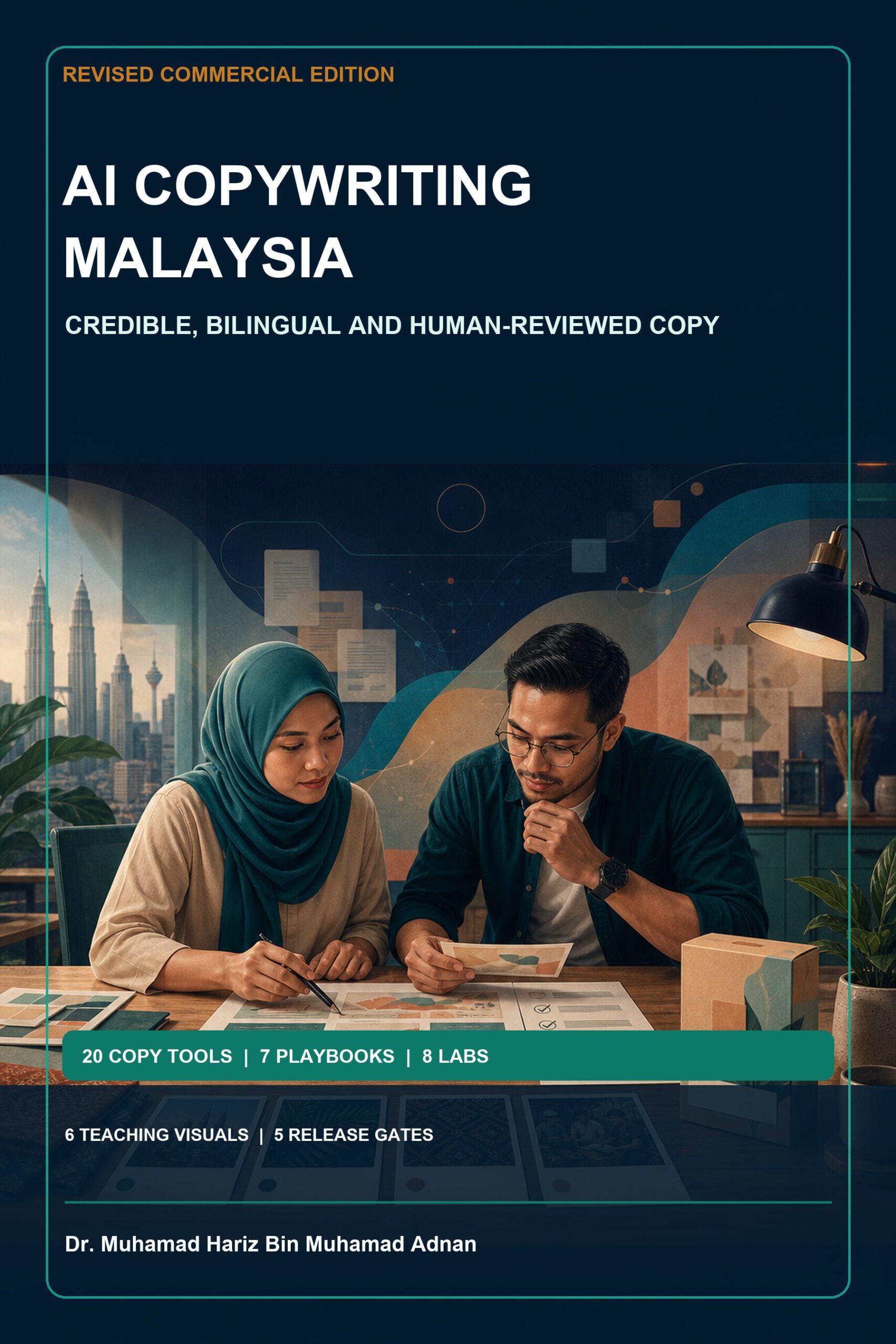
The complete AI Copywriting Malaysia ebook expands this workflow with 20 reusable templates, seven Malaysian playbooks, eight guided labs, bilingual review tools and a 14-day plan.
A short product-description checklist
- The product name and version match the final item.
- Format, size, quantity and requirements are verified.
- Benefits follow logically from approved features.
- Prices, dates and availability have a responsible owner.
- Testimonials and comparisons are authorised and accurately represented.
- Important conditions appear near the relevant claim.
- The CTA goes to the correct live destination.
- The delivery or enquiry step is explained truthfully.
Run the checklist against the rendered live page, not only the draft in a document. A missing paragraph, stale cache, broken button or mobile layout problem can change what the customer sees. Record any correction and repeat the check after the update.
Measure clarity without inventing certainty
After publication, observe questions, page behaviour and completed customer paths in the approved analytics and support systems. A change in clicks or sales does not automatically prove that one sentence caused the result. Record the dates, traffic source, offer changes and other differences before drawing a conclusion. Use small, honest tests: change one presentation element while keeping the underlying offer and evidence stable. Do not strengthen a claim simply because a more dramatic version attracts attention.
Customer questions can reveal unclear wording, but handle the underlying messages carefully. Summarise themes without names, phone numbers, order details or unique stories before using an AI tool, and only use an approved account. Correct repeated confusion on the page itself rather than expecting customers to find an explanation elsewhere. When the offer, price, availability or policy changes, update the master fact sheet first and then review every derived caption and advertisement.
Malaysia privacy and responsible-AI checks
Do not paste identifiable customer conversations, order histories or private profiles into an unapproved tool. Malaysia’s NAIO privacy and security guidance emphasises data governance, access, risk assessment, vendor review and retention. The Personal Data Protection Department explains the Act’s application to personal data in commercial transactions in the circumstances it describes. Check the current requirements for your organisation and obtain appropriate advice.
Worked Malaysian example: a digital planner
A Malaysian seller offers a printable weekly planner with three PDF sizes, two colour themes and a short printing guide. An AI draft says the planner will transform productivity instantly. The source sheet cannot support that outcome, time claim or implied guarantee. A safer lead names the verified contents and the practical choice they provide: buyers can select a supplied size and theme for their own printing setup. The page should also state clearly that this is a digital product and explain what happens after purchase.
During Bahasa Malaysia review, freeze the quantities, file format and product name. Check that the delivery explanation does not imply a physical parcel and that the CTA describes the real purchase step. Then open the published page on a narrow screen. If the digital-product notice falls below a long gallery, move it into the early summary and repeat the live check. The final evidence packet should contain the approved source sheet, exact released wording, reviewer, page URL and verification time.
FAQ
Can AI invent a customer testimonial?
No. Use only authorised, accurate customer evidence and do not change a speaker’s meaning.
Can I publish the first draft?
Treat it as unapproved until a human verifies claims, language, conditions, links and the live offer.
Should I write in English or Bahasa Malaysia?
Follow the audience and channel evidence. Use a proficient reviewer and check useful terminology through PRPM.
Does better copy guarantee sales?
No. Results depend on the offer, audience, price, channel, experience and many other factors.
How often should I update a description?
Set a review trigger for changes to the product, file, price, stock, date, delivery, policy, evidence or destination. Time alone is not the only trigger: a repeated customer question or broken link also deserves review. Update the source sheet first, then correct every derived version and record what changed.
Conclusion
AI is most useful when it helps organise verified facts and explore clear wording. The business must still own every claim and every live customer path. Begin with one product, one audience and one page. Build the evidence first, review each sentence, and stop if the final CTA or offer cannot be verified.
Ready for the full system? Get AI Copywriting Malaysia for RM9.99 and use the source-pack templates, claim controls, bilingual checks and practice plan.