SOP Checklist Malaysia: 18 Checks Before You Release a Procedure
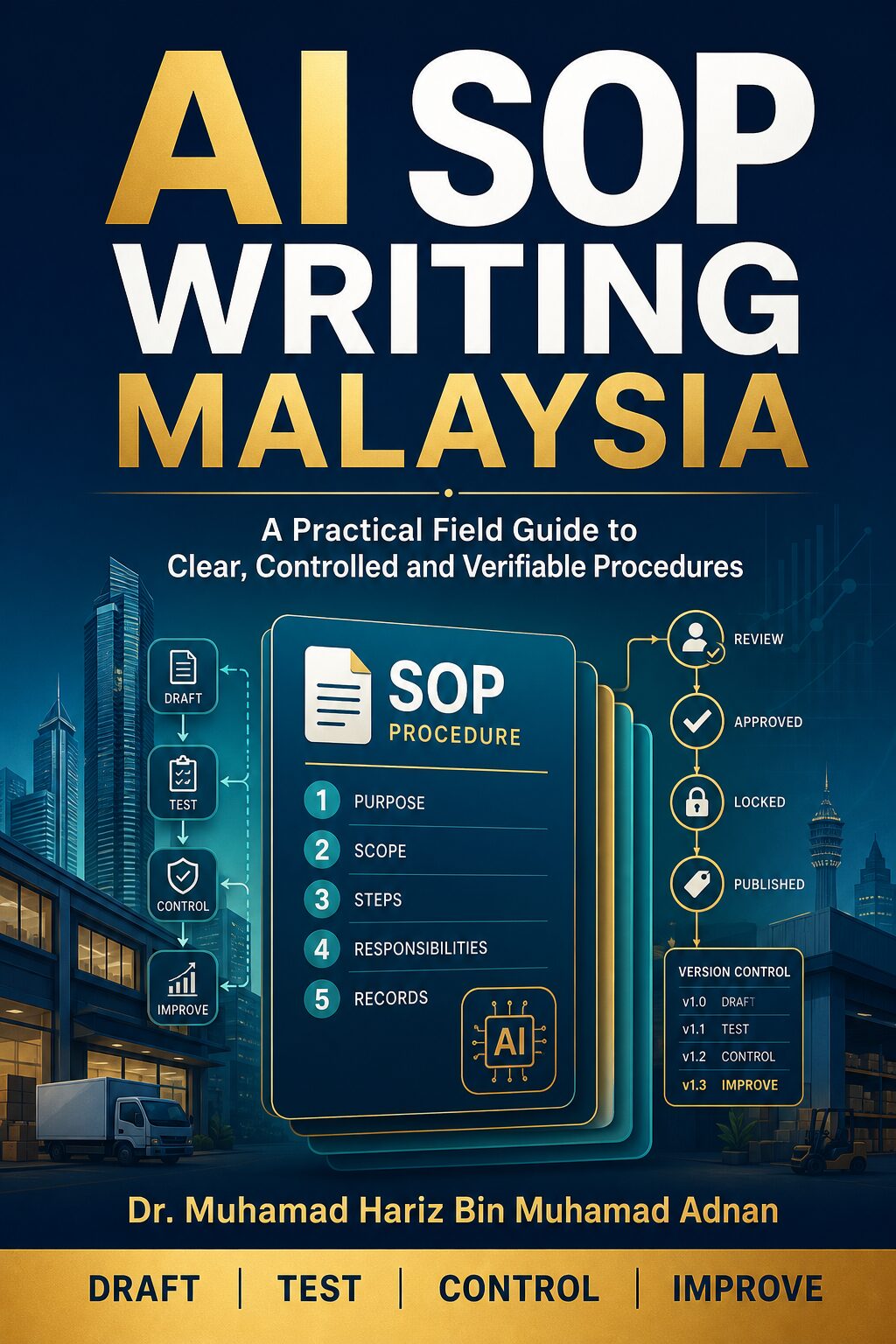
Early answer: Before releasing a standard operating procedure, verify that it describes real work, names the owner and boundary, gives users executable steps, handles exceptions, protects information, has passed a realistic pilot and is the exact version being deployed. AI can help organise evidence and improve language, but a responsible human must verify every material instruction.
By Dr. Muhamad Hariz Bin Muhamad Adnan
A Malaysian SME may create an SOP because work varies between branches, a new employee needs guidance, a customer requires evidence, or a recurring error needs control. The temptation is to ask an AI tool for a complete document. That can produce fluent pages quickly, yet fluency does not reveal your actual system permissions, informal queues, current forms, bilingual terminology or the person authorised to accept risk.
1. Confirm an SOP is the right control
Start with the last few failures. Would a competent person following a clear instruction have prevented them? If the real cause was a disabled validation rule, missing equipment, impossible workload, conflicting targets or absent access, fix that condition. The procedure can explain the redesigned process, but it should not carry a system problem that management has left unresolved.
2. Observe a normal and difficult case
Watch work from the trigger to a measurable done state. Record actors, systems, decisions, waits, workarounds, hand-offs and records. Then study a boundary or exception: incomplete information, an unavailable approver, an outage or a rejected hand-off. Mark every assumption as UNKNOWN. Do not let the AI tool invent a missing step simply because a complete sequence looks professional.
3. Build a source and claim register
List the current policy, contract, system rule, manufacturer instruction, approved form and subject-matter decision that support important steps. Record owner, version, effective date and exact section. If sources conflict, the accountable owner must resolve them. An AI summary or web article may help locate questions, but it is not the controlling authority for your organisation.
4. Define scope, stop conditions and ownership
Name the sites, products, systems, roles and case types covered. State exclusions and observable stop conditions. Separate the process owner, document custodian, performer, reviewer and approver even when one person wears several hats. For legal, safety, employment, finance, health or regulated matters, obtain competent specialist review and retain human authority.
5. Write steps people can execute
Replace vague lines such as “check the details” with an action, object, location, condition, expected result, evidence and failure route. Keep system labels exact. Use a small terminology register for English and Bahasa Malaysia so words for review, verification, permission and approval do not collapse into one ambiguous term.
6. Control AI inputs and outputs
Use only an approved AI environment and permitted information. Minimise data, remove unnecessary identifiers and prefer synthetic structures for drafting practice. Redaction is useful but does not automatically create permission. Tell the model to preserve UNKNOWN items, cite supplied evidence and avoid inventing thresholds. A human reviewer should compare each material output with direct sources and observed work.
7. Pilot normal, boundary, exception and recovery cases
Ask intended users to perform realistic cases without author coaching. Observe searches, pauses, questions, skipped steps and the records produced. Log each defect with the condition, impact, owner, correction and retest. If a change affects a decision, form, language term or link, identify the blast radius and repeat downstream checks.
8. Approve, deploy and withdraw as one release
The approved record must identify the exact version. Publish that controlled copy, brief affected users, verify access and remove or clearly mark superseded copies at real points of use. A message saying “new SOP attached” is not deployment if old bookmarks, local files and printed folders remain active.
9. Use a five-gate release workflow
Gate one checks sources, scope, claims, unresolved UNKNOWN items and data permission. Gate two checks flow, decisions, roles, records, terminology, links and readability. Gate three observes real users performing representative cases. Gate four records specialist review where required, accountable approval, version identity and effective date. Gate five verifies the exact approved copy is deployed, accessible and monitored while old copies are withdrawn.
A gate needs a named owner, evidence and a pass rule. “Reviewed in the meeting” is weak because it does not show which source, case, version or defect was examined. When a correction changes an input to a later gate, repeat the affected downstream checks. That discipline prevents a small wording or form change from escaping into an untested operational branch.
10. Monitor the procedure after release
Choose a few signals connected to the process: first-pass completion, rework at a named step, unresolved exception age, record defects, user questions or recovery time. Treat them as investigation signals, not instant proof that the SOP caused an improvement. Pair trends with a small sample of records and frontline feedback so better numbers do not hide unreported workarounds or transferred effort.
Set event-based review triggers as well as a calendar date. A system update, new form, changed role, revised customer requirement, incident or recurring stop may make the document inaccurate immediately. The process owner decides whether to suspend, issue a controlled temporary instruction or start a formal change. The document custodian maintains identifiers, links and withdrawal evidence.
A Malaysian SME example
Consider a small Selangor distributor documenting supplier onboarding. Observation shows that sales requests a supplier, administration checks documents, finance verifies bank evidence and a manager approves activation. The email hand-off does not state the minimum pack, so finance repeatedly returns cases. An AI-generated SOP might smooth this into four steps and miss the queue entirely.
The team instead creates a hand-off contract: sender, receiver, required documents, case ID, secure channel, acceptance check and rejection route. It keeps personal and banking evidence in approved systems, gives AI only a synthetic field list for wording assistance and tests one complete, one incomplete and one duplicate case. The release record identifies the approved version and the old shared-drive copy is marked superseded.
When the writer should stop
Stop drafting when a material threshold has no authoritative source, two current instructions conflict, the proposed user lacks the required access, a safety or legal question exceeds the team’s competence, or the workflow depends on sharing information through an unapproved channel. Record the exact issue, affected step, temporary safe state and owner. A visible stop protects the organisation better than a plausible paragraph that quietly chooses an answer.
The same rule applies during review. If the tester needs coaching, the case leaves scope, the record cannot be retrieved or the approver is asked to sign a file that differs from the pilot version, mark the gate as failed. Correct the underlying process or document, determine which evidence became invalid and repeat the relevant test. A failed gate is useful control evidence; an unexplained green status is not.
The 18-check SOP release list
- The operational problem and intended outcome are explicit.
- An SOP was chosen after considering stronger system or authority controls.
- Normal and difficult work was observed or evidenced.
- Every material claim has a current source and owner.
- Scope, exclusions and stop conditions are observable.
- The trigger, done state, waits and hand-offs are mapped.
- Decision rules name authority and permitted outcomes.
- Each important step has an action and acceptance result.
- Exceptions have containment, escalation and recovery routes.
- Roles, delegation and competence evidence are clear.
- Forms collect only necessary, usable information.
- English and Bahasa Malaysia carry equivalent meaning.
- AI use follows approved data and tool boundaries.
- AI-assisted statements were checked against direct evidence.
- Normal, boundary, exception and recovery cases passed pilot.
- Defects were corrected and affected tests repeated.
- The approver signed the exact version and effective date.
- Deployment, user access and old-copy withdrawal were verified.
Use the complete field system: Get AI SOP Writing Malaysia for RM9.99 to work with 20 reusable tools, seven role playbooks, eight practical labs and the five-gate SOP release workflow.
Safety, privacy and fact-checking
Malaysia’s current AI-governance guidance emphasises responsible use, including privacy, security, transparency and accountability. The Personal Data Protection Department provides the current Act and amendment or guideline links for personal-data questions. Open the current official source, confirm scope and effective date, and obtain specialist advice where needed. Do not treat this article as legal, safety, certification or sector-specific advice.
FAQ
Can AI write an SOP from scratch?
It can draft a structure, questions or language. It cannot establish local operational truth or approve risk. Begin with observation, evidence and ownership.
How long should an SOP be?
Use the shortest format that supports safe, consistent execution. Move reference material to controlled attachments and remove text that does not change an action or decision.
Is reading acknowledgement enough?
No. Receipt is not competence. Use observation, sample work, questions or a controlled simulation appropriate to the consequence of the task.
How often should it be reviewed?
Use a risk-based cadence and event triggers such as changes to systems, roles, sources, incidents or the process itself.
Official sources
- Government of Malaysia: National Guidelines on AI Governance and Ethics
- Malaysia National AI Office: Practical Guide to AI Governance and Ethics
- Department of Personal Data Protection: Act 709 and current guidance
- ISO 10013:2021 documented information overview
- SME Corp Malaysia business guides
Build the controlled version: Download AI SOP Writing Malaysia for RM9.99 and follow the evidence, design, execution, governance and deployment gates before release.