How to Make AI Voiceover in Bahasa Malaysia: A Five-Gate Workflow
By Dr. Muhamad Hariz Bin Muhamad Adnan
Short answer: To make an AI voiceover in Bahasa Malaysia, define the listener and approved message, choose an authorised synthetic voice, rewrite the source for listening, build a pronunciation lexicon, generate labelled segments, check the audio without reading, correct captions from the final take and release only after a human owner verifies the real destination.
A natural voice is not evidence that a script is true, that a cloned identity is authorised or that Malaysian terms are pronounced correctly. The practical goal is a traceable audio-caption pair: every important line points to an approved source, every voice route has a rights basis, and every public file has a named owner who can correct or withdraw it.
Begin with a legitimate listening job
Choose a short, low-risk use case such as a product-care tutorial, a revision aid built from your own notes, a software walkthrough or an internal training explanation. Name the listener, the action they should take after listening, the destination, approximate duration, language mix and human release owner. Also write the non-goals. A care guide should not quietly become a performance guarantee; an educational explanation should not make assessment decisions; an internal clip should not be republished as an advertisement without a new review.
Freeze the written source before scripting. List the facts that can change, including dates, prices, eligibility, contact details, interface steps and safety conditions. If two approved documents conflict, return the issue to the content owner. Synthetic speech can make uncertain wording sound confident, so missing authority must remain visible rather than being filled with plausible language.
Separate text-to-speech from voice cloning
Text-to-speech normally renders a script with a stock or designed synthetic voice. Voice cloning creates a voice from recordings associated with a person and introduces stronger identity, consent and impersonation risks. Most beginner projects do not need a clone. Start with a licensed synthetic voice whose permitted use fits the project and whose data handling you have checked.
If a voice could be associated with an identifiable person, obtain explicit permission that matches the actual use, channels, audience, duration, editing rights and disclosure. A generic recording release should not be treated as permission to create a reusable synthetic identity. OpenAI’s discussion of synthetic voice safeguards describes consent and disclosure as central controls, while current provider documentation should be checked for the exact service and account being used.
Rewrite the source for the ear
People cannot scan backward through speech as easily as they reread a page. Use one main idea per sentence, introduce the purpose early and put conditions next to the action they limit. Expand ambiguous abbreviations, dates and figures into one intended spoken form. For example, decide whether 03/08/26 means 3 August 2026 before generation. Decide how RM9.99 should be spoken for the audience instead of leaving punctuation to the model.
Read the script aloud yourself. Mark pauses at meaning boundaries, not wherever a line wraps. Keep negatives such as not, except, unless, jangan and tidak audible and close to the affected phrase. Performance direction should explain intent, pace and emphasis without asking the voice to compensate for a confusing sentence. If the line is hard for a human to say clearly, repair the script first.
Build a Malaysian pronunciation lexicon
Create a short table with the written term, intended language, confirmed pronunciation source, tool-specific cue, example sentence and reviewer status. Include Malaysian names, places, institutional terms, product names, acronyms, numbers and English-Bahasa Malaysia code-switches. Confirm personal names with the person or an authorised source. For terminology, use an appropriate current reference such as PRPM by Dewan Bahasa dan Pustaka, then still test the complete phrase in the selected voice.
Code-switching often fails at the boundary rather than inside either language. A tool may change accent, stress or pace after one English product name. Generate short boundary tests that include the words before and after the switch. Ask a proficient Malaysian reviewer to listen without seeing the spelling. Phonetic respelling is an implementation aid for one tool and voice; it is not a universal language rule.
Audition voices with one fixed calibration set
Compare candidate voices using the same short passage. Include a local name, a date, currency, a negative condition, a code-switch, a sentence with emotional restraint and the synthetic-voice disclosure. Score intelligibility, Bahasa Malaysia quality, English quality, pacing, control, edit effort, rights clarity, data handling and export suitability. Keep unknowns as unknowns rather than awarding a confident score without evidence.
Listen on headphones and an ordinary phone speaker. Test the provider’s current interface, supported formats and policy directly because features and limits change. The OpenAI audio documentation and ElevenLabs text-to-speech documentation are examples of primary sources for current capabilities, but neither proves that a particular voice is suitable for your language, rights context or audience.
Generate in controlled segments
Lock a numbered script and split it by complete ideas. Use stable IDs such as S01, S02 and S03. Log the voice, settings, generation time, take label, reviewer and decision. Generate one or two representative segments before committing to the whole project. When something fails, change one main variable so the team can tell whether the repair came from wording, punctuation, pronunciation guidance, voice choice or delivery settings.
Do not improvise new claims inside the voice interface. A change to a material line belongs in the approved script, not only in an isolated audio take. If S04 changes, update the script version, regenerate its caption text, check the transitions around S03 and S05 and record the selected replacement. Rejected takes should be separated from approved material so they cannot accidentally return during assembly.
Edit for comprehension and caption the final audio
Assemble only approved takes. Remove distracting clicks and excessive silence without cutting consonants or breaths that carry meaning. Keep music below speech and use only licensed assets. Review pacing as a sequence: a series of individually acceptable clips can still feel rushed after assembly. Preserve enough natural pause for a listener to process dates, instructions and transitions.
Captions are a second deliverable, not an automatic by-product. Correct them from the final selected audio rather than an earlier manuscript. Check names, numbers, punctuation, line breaks, timing and disclosure. Provide a stable written route for detailed conditions and changing information. A viewer with sound off should receive the same material message, while a listener should be able to find the current written source and correction channel.
Use five release gates
- Brief: confirm the listener, approved source, purpose, destination, owner and non-goals.
- Rights: confirm the voice class, permission, intended-use scope, disclosure and withdrawal evidence.
- Language: verify Malaysian terms, names, dates, currency, negatives, register and code-switches with a proficient reviewer.
- Audio and captions: listen to the complete export, compare it with the source and verify the exact caption file on the destination.
- Human release: record the exact versions, reviewer, decision, live URL and next review trigger.
One failed gate returns the exact version to repair, escalation or retirement. Do not add generic warnings around a faulty line. Find the first broken control. A wrong negative in the script needs a source-to-script repair; missing voice permission needs an owner decision; caption drift needs a final-audio alignment pass.
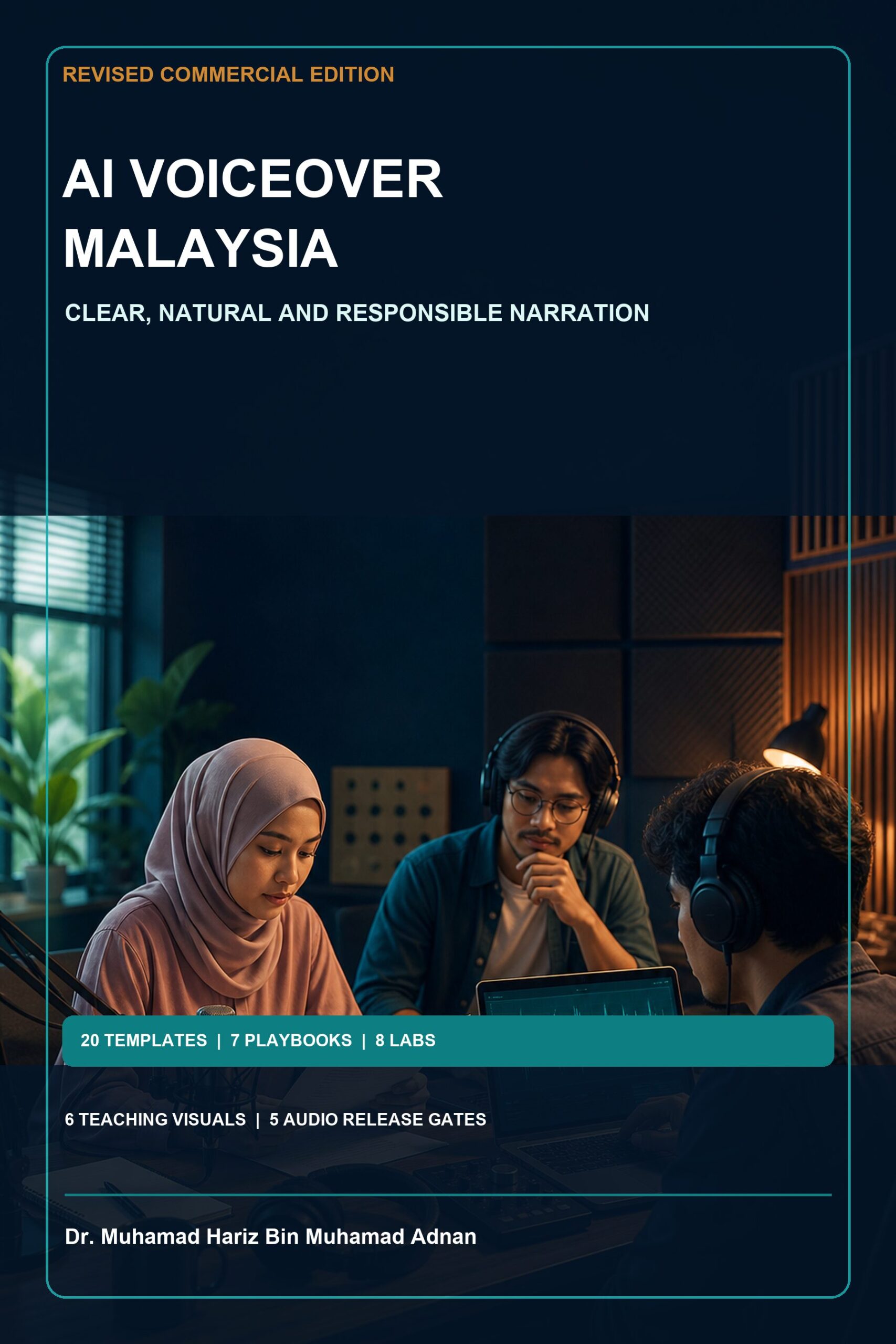
The revised AI Voiceover Malaysia commercial field guide expands this workflow into 20 production templates, seven Malaysian role playbooks, eight practical labs, twelve clinics, six teaching diagrams and a 14-day implementation plan.
A compact no-script listening test
Ask a reviewer who did not write the script to listen once without captions. They should repeat the purpose, main action, every critical number or date, any exception and the disclosure. Record what they heard rather than telling them what they were supposed to hear. If a critical item is wrong or uncertain, the version fails even when the reviewer likes the voice.
Repeat the test on the actual target device and after upload processing. Check the first and last words, segment joins, loudness, captions, written link and correction route. Archive the released audio and caption filenames plus a checksum when practical. Reopen review when the source, consent, voice, terminology, provider, audience or destination changes.
Responsible-use and privacy checks
Remove personal data and confidential notes that are not needed for generation. Use synthetic examples during testing. Store consent records and sensitive source recordings in an approved access-controlled system rather than a reusable prompt folder. Review the selected provider’s current data controls and your organisation’s rules before uploading protected material. Malaysia’s Personal Data Protection Commissioner is the primary national source for current personal-data guidance; this article is general education, not legal advice.
Never present a synthetic voice as proof that a person spoke, approved or endorsed the message. Make disclosure easy to notice in the medium where the audio appears. Provide a route to the current written information and a way to report an error. Human ownership matters most after publication, when a stale price, changed policy or withdrawn permission requires fast correction.
FAQ
Which tool is best for Bahasa Malaysia voiceover?
There is no permanent universal winner. Test the exact Malaysian names, register, code-switches, rights path, privacy controls, export needs and editing effort for your project. Record the test date because provider capabilities change.
Must I clone a voice?
No. A licensed stock or designed synthetic voice is the safer default for most tutorials, explainers and learning material. Cloning requires a stronger consent and identity-governance case.
Is disclosure enough if the voice resembles a celebrity?
No. A disclaimer does not create permission or remove impersonation risk. Stop and choose an authorised voice route.
What if audio and captions disagree?
Do not publish. Decide which approved source is correct, repair the script or selected take, regenerate the caption file from the final audio and rerun the release gates.
Can AI replace a proficient language reviewer?
No. A tool can propose alternatives, but an accountable reviewer familiar with the intended Malaysian audience must decide whether meaning, pronunciation, register and cultural fit are acceptable.
Conclusion
Responsible AI voiceover is a publishing system, not a one-click voice effect. Control the source before performance, prefer authorised synthetic voices, test Bahasa Malaysia in complete phrases, manage segments and takes, correct captions from the final audio and keep one person accountable for release and correction.
Ready to build the full system? Get AI Voiceover Malaysia for RM9.99 and use the revised templates, playbooks, labs, diagrams and five-gate release room.