How to Translate English to Bahasa Malaysia with AI
To translate English to Bahasa Malaysia with AI, first define the reader and purpose, freeze the source, protect names and private information, provide an approved glossary, require the tool to flag ambiguity, and compare the final target with the source before publishing. A fluent output is only a draft until a competent human verifies meaning, terminology, numbers, conditions and tone.
Malaysian users often need more than a literal language swap. A product page, workshop reminder, help article or mobile button must fit its audience and channel while preserving the facts. The workflow below is designed for low- and moderate-risk content. Contracts, medical or safety information, regulatory material and other high-impact text need authorised specialist processes.
1. Define the target precisely
Do not prompt only “translate to Malay.” State that the target is Bahasa Malaysia or Malaysian Malay, identify the reader, choose a register and name the channel. A neutral public instruction, a warm customer reply and a short interface label have different requirements.
Use a brief with purpose, audience, target variety, channel, source version, glossary, protected elements, layout limits, risk class and reviewer. This prevents a model from making hidden decisions about tone or terminology.
2. Freeze and clean the English source
Translation cannot repair an unclear source reliably. Resolve ambiguous pronouns, dates, undefined acronyms and contradictory instructions with the source owner. Assign a version and list text that must not change, including names, numbers, product codes, URLs and variables such as {order_id}.
Break long content into coherent sections with stable IDs. This makes omissions and duplicates easier to detect when the target is reassembled.
3. Protect personal and confidential information
Use the lowest amount of information that can complete the task. Replace names, email addresses, account numbers and other unnecessary details with stable placeholders. Check comments, document properties, headers, footers and filenames as well as visible body text.
Malaysia’s Personal Data Protection Department publishes the Personal Data Protection Act and related guidance. Whether a specific workflow is lawful depends on the facts, roles and current provisions, so consult authorised privacy or legal functions when personal data is involved. See the JPDP Act publication.
4. Build a small approved glossary
List recurring concepts before translating. For each term, record the source, approved target, definition, example, rejected alternatives, owner and review date. The same English term may need different Bahasa Malaysia choices in a product interface, training handout or formal document.
Dewan Bahasa dan Pustaka publishes Bahasa Melayu guides and operates PRPM. Use official resources as evidence, alongside the project’s domain glossary and competent human review.
5. Use a controlled prompt
Try this tool-neutral structure:
Translate the delimited authorised source from English into clear Bahasa Malaysia for [reader] in [channel]. Purpose: [ ]. Preserve exactly: [names, numbers, dates, variables, URLs]. Approved terms: [source = target]. Do not translate: [ ]. If a phrase is ambiguous, insert [CLARIFY: reason] and do not guess. Return the target, uncertain/adapted phrases, and a checklist of every number, condition, negation, link and placeholder for human verification.
Keep instructions outside the source delimiters. Ask for alternatives with explanations when a term is disputed; do not let the model silently approve a glossary entry.
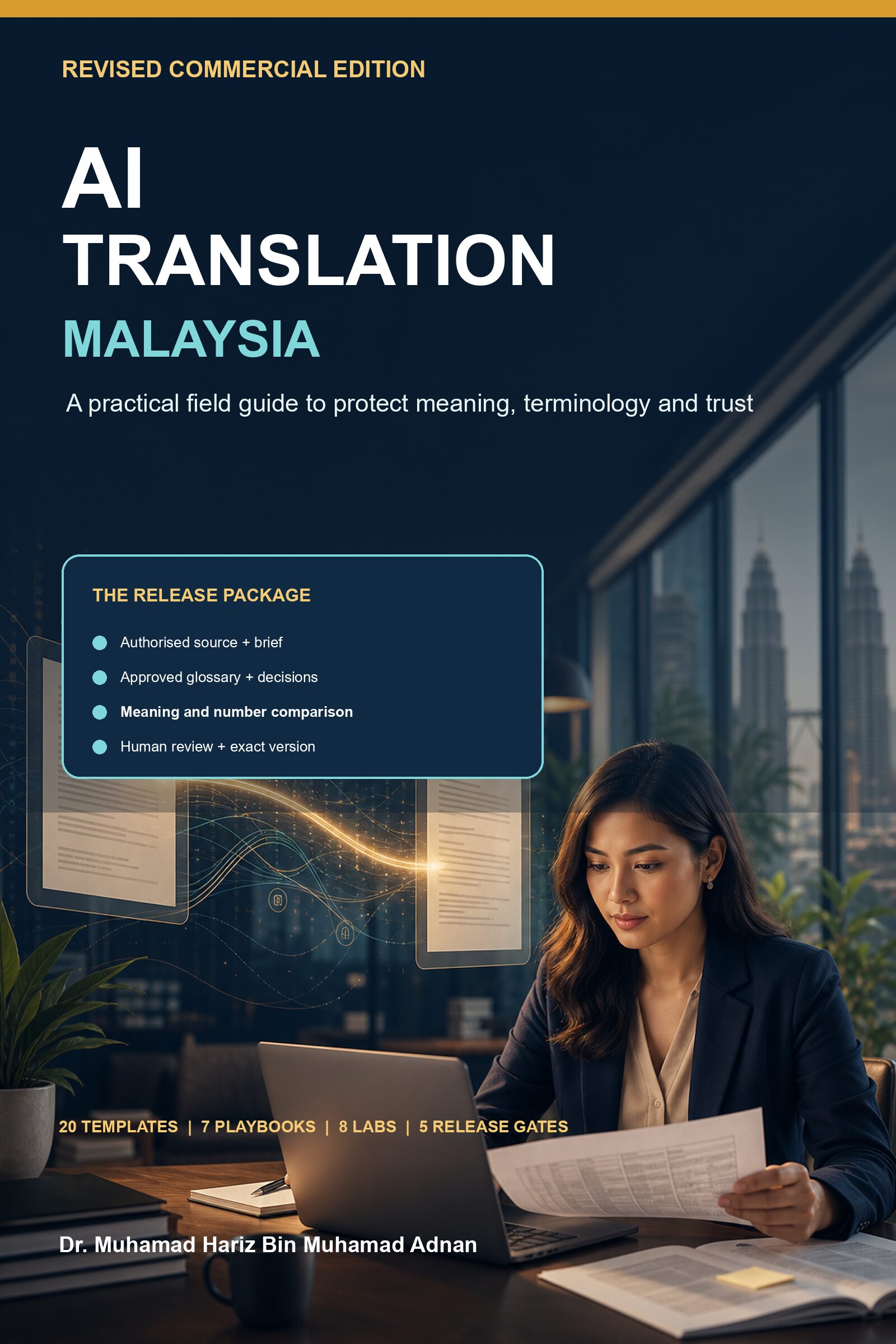
Need the full set of templates and review cards? Get AI Translation Malaysia for RM9.99. The 59-page searchable PDF includes 20 translation templates, seven Malaysian playbooks, eight labs and a 14-day implementation plan.
6. Review meaning before style
Compare the source and target in meaning units: actor, action, object, condition, time, quantity, permission, prohibition and degree of certainty. A polished sentence fails if it drops a return condition, changes “may” to “will,” or turns a proposed date into a promise.
Only after meaning is stable should you improve naturalness. Ask for a change log and compare the revised version with the source again. “More natural” is not permission to add marketing claims or remove qualifications.
7. Verify the mechanical details
- Names, organisations and product labels match authorised sources.
- Dates, times, quantities, units, percentages and RM amounts retain their value.
- Negation, conditions, exceptions and uncertainty are preserved.
- Links open the intended destination.
- Variables, HTML tags, IDs and shortcodes remain valid.
- No placeholder or private metadata remains in the final file.
8. Test the real layout
Bahasa Malaysia text may wrap differently from English. Inspect the actual web page, document, subtitle or interface at relevant screen sizes. Check headings, tables, buttons, error messages, mobile wrapping, alt text and reading order. Change the design when necessary rather than shrinking text until it is uncomfortable.
9. Use back translation only as a clue
A back translation can reveal a missing condition or surprising shift, especially when a reviewer cannot read the target. It cannot prove correctness because two systems may repeat the same error and several good translations can map back differently. Direct bilingual comparison remains essential.
10. Record human approval
Save the source version, target version, glossary/style version, review findings, corrections, reviewer, approver and release date. High-impact content needs the organisation’s specialist route. Do not imply that a professional translator certified the work unless that is true.
Quick Bahasa Malaysia translation checklist
- Purpose, audience, variety and register are clear.
- The source is final and owned.
- Input is minimised and approved.
- Names, numbers, links and variables are locked.
- Glossary decisions have evidence and owners.
- Ambiguity is flagged rather than guessed.
- A competent reviewer compares target with source.
- The final layout and metadata are inspected.
Five common mistakes to avoid
Translating an unstable source
If the English source is still changing, every Bahasa Malaysia correction can be overwritten or detached from its evidence. Freeze a version before translation. When the source changes, compare versions and re-review affected segments rather than starting from memory.
Using “professional” as the whole tone brief
Professional can mean concise, formal, warm, firm or technical in different settings. Name the relationship, reader knowledge, desired action and acceptable directness. Ask the tool to explain which phrases create the proposed register.
Letting naturalness erase a condition
A stylistic revision may shorten a sentence by removing “if,” “unless,” “subject to” or “may.” Underline every condition, exception, permission and prohibition in the source, then verify them after each rewrite.
Approving isolated strings
A button label or error message can look correct in a spreadsheet but fail on screen. Give translators screenshots, character limits, variables and surrounding actions. Test the target in the real interface and at a narrow mobile width.
Measuring only speed
Fast output with hidden defects creates rework and risk. Track critical and major errors, terminology consistency, reviewer effort, layout failures and reader comprehension. A small pilot with honest defect records is more useful than a large volume count.
A safe first practice exercise
Create a fictional workshop reminder with a date, time, venue, one instruction and one attendance condition. Do not use a real participant’s name or email address. Mark the meaning units, decide whether the room name should remain in English and build a five-term glossary.
Ask the AI system to translate the reminder into neutral Bahasa Malaysia and to list every date, time, condition and proper name for checking. Plant one ambiguity, such as an unclear numeric date, and verify that the system uses a clarification marker instead of guessing. Compare the target clause by clause, then read it alone for naturalness.
Finally, place the text into a simple mobile-width layout. Look for awkward wrapping, a hidden condition or a room label that no longer matches the venue sign. Record the source version, target version, reviewer and final decision. This exercise rehearses source control, prompting, meaning review, language review and layout QA without exposing real confidential information.
Repeat the exercise with English as the target and compare which glossary, register and layout decisions change; bilingual quality is directional, not automatically symmetrical across audiences, channels, domains or document versions.
FAQ
Is AI translation accurate enough for business?
It may assist low- and moderate-risk work, but quality varies by domain, context, language pair and source. Define acceptance criteria and use human review. High-impact documents need authorised specialist controls.
How do I prevent Indonesian wording?
Specify the Malaysian target variety, provide approved Malaysian terminology and involve a competent reviewer. Do not reject every unfamiliar term without checking its context and source.
Can I paste a confidential document into an AI tool?
Only if the exact account and workflow are approved for that information. Minimise content and consult authorised privacy, security and legal functions.
Does Google or Microsoft support Malay?
Current official documentation lists relevant Malay capabilities, but support, interfaces and plans can change. Verify the exact current product. See Google Translate Help and Microsoft Translator language support.
Conclusion
A safe AI translation workflow makes uncertainty visible. Define the reader, protect the source, control terminology, preserve every material condition and let an accountable human approve the exact final version.
Build the complete workflow: Download AI Translation Malaysia for RM9.99 and use the 20 templates, role playbooks, practice labs and print-ready review cards.
By Dr. Muhamad Hariz Bin Muhamad Adnan. AI output may be incomplete, outdated, biased or wrong. Verify important facts against current primary sources.